

If you do more sets, do you get more muscle growth?
This question has persisted throughout training for thousands of years.
-Take Neurovolt and you will have the cognitive energy for high volume lifting AND thinking.
Its a reasonable question and line of thinking. In most athletic endeavors, more training produces a higher level of athlete.
Whether the training is perfectly efficient is secondary. For classic competition activities, for example running, to run far you must practice running far.
In fighting, the more you fight, the better you become.
But what about growing muscle tissue?
The volume argument has run continuously since Jones started selling Nautilus machines in 1970.
Arthur Jones said you could do one set and everyone else was doing junk training.
Mike Mentzer adopted this philosophy and it turned into Heavy Duty. Dorian Yates later took up the mantle of intensity. So did Dante Trudel, with the argument the long term strength gains with big weights matters most of all.
These are not bad arguments.
But on the opposite side, there is also the undeniable reality that the majority of bodybuilders, both natural and enhanced, and at the highest levels of competition, they did A LOT of sets.
From the High Volume position, each hard set is a growth signal.
Signals accrue the more sets you do, so the lifter putting 20 quality sets into a muscle each week sends 4 times the signal of the man doing 5, and the size difference over time reflects it.
The “science” does directionally support this.
Schoenfeld, Ogborn, and Krieger pooled 15 studies in 2017 and found a graded dose response.
Lifters doing 10 or more weekly sets per muscle gained measurably more size than lifters under 5, and each added set bought additional growth.
Radaelli’s 2015 trial ran men through 6 months at 1, 3, or 5 sets per exercise.
The 5-set group built the most muscle at nearly every site measured.
Schoenfeld tested it again in 2019 on trained lifters, the population that supposedly needs less, and the group running 30 to 45 weekly sets grew the most quad and triceps thickness of the three conditions.
Thats not to say that everyone should be doing 30 sets, but double digit sets is historically Common
Silver Age natural bodybuilders often followed full body routines and did 10-20 sets per muscle per week. They had specialization routines which consisted of double digit sets for each muscle.
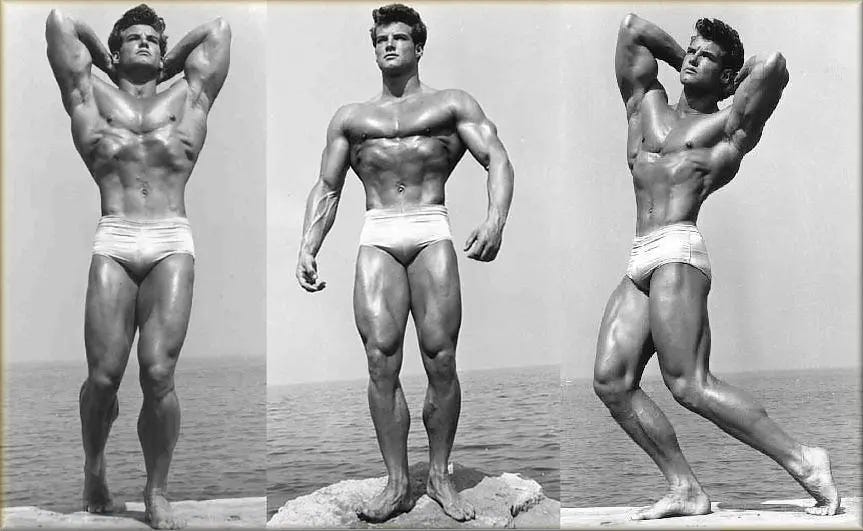
Steve Reeves trained total body 3x a week, for 2-3 hours. Never did less than 10 sets a week per muscle
Vince Gironda considered 12-15 sets the ideal.
Every Mr. Olympia up to Dorian Yates followed a high volume program, as did every Mr. Olympia after him.
In the natural bodybuilding world, the majority of champions follow moderate to higher volume programs.
To say high volume training does not work is bullshit.
It CLEARLY works and has worked for decades.
Is High Volume the BEST way to train though?
This the question that starts stupid arguments.
Training is N=1 because
A) Its hard to define “best”. The reality of genetics means that some people will ALWAYS be low responders to training stimulus.
Best for them means finding a stimulus they can adapt to.
And within this “hardgainer” population, you have people who respond best to low volume and get overwhelmed and dont recover from too much volume.
Then you also have people who only respond to high volume and have stimulus threshold level that must be crossed before they grow.
You then also have the Moderate Middle, people with “average” genetics.
You have people that excel with lighter weights. You have people that can grind out super heavy singles. You have differences in structure, muscle bellies, tendons, joints.
Then you have the FREAKS. They grow from anything, and it doesnt seem to matter how they train, because they adapt regardless. Most every Olympia champion had freak genetics before they ever took steroids.
B) The body changes over time. As people get bigger, stronger, more kinesthetically intelligent, their training evolves. There is also the fact the changes in stimulus are needed to keep adapting, and this can can come from manipulation of volume, intensity, and rep ranges. There is no set science to this, its an N=1 art form
C) Recovery capacity can and does increase. There is a false belief that your ability to recover from resistance training is finite. This is untrue. Similar to aerobic training, the body can handle larger volumes over time. Does this mean more muscle tissue? Maybe it does, provided training is intelligent. Someone who has never trained can be tired from 6 moderate sets for a muscle. Someone who has trained for 20 years and is stronger could do 18 sets. Do they NEED to do 18 sets to grow? Not necessarily, but it is TRUE that they are capable of higher output and can recover from more training.
D) personality plays a huge role. Some people love the concept of high intensity and are drawn to practice it. Others are not. Some try it and quit. Others stay with it for many years.
E) the body ages over time. Training age shifts it, sleep shifts it, a stressful quarter at work shifts it, and 40-year-old recovery is not 25-year-old recovery. The man who grew on 20 sets at 28 may be handling only 10 at responder at 50. Or maybe he trained higher intensity when he was young, and now trains higher volume, more moderate weights being older.
F) Response to training is fat tailed. This where the bell curve model of thinking is misleading. When you actually TRAIN clients, and have trainees (Ive had tens of thousands who have used my programs), you realize learn that EVERY training style works, and that unusual adaptive responses will happen. Ive had people who sent me results of putting on 20lbs of muscle of from low, moderate, high volume, high frequency, low frequency, 3 hours a week, 6 hours a week, and every mix thereof. You dont KNOW until you try something.
That's the whole practical lesson of N=1
When a trait is bell-shaped, the average is a reliable prescription and you can follow it.
When it has a long tail, the average tells you where to start and nothing more, because the tail is populated enough that you might be in it.
The exercise science research gives us the mean, and it gives a start point. We know that about 4 sets is the minimum. About 10 sets is the middle.
But only your personal experience tells you whether you're a center-of-the-curve responder or a tail case, and there's no way to know but to run the dose, do a program, and see what results you get.
…all i want for Xmas this year is a pair of fkn VMOs.
(working on it, Santa only helps those who help themselves, i hear…)
Screw the lower weights just because I’m over 50. I just read the other day you loose strength 2X as fast as muscle! I’m also taking peptides, not going down without a fight 🤣🤣