

Hypertrophy is the science of muscle growth.
We know based on human history and modern evidence that gaining muscle is not random. The earliest human civilizations did not need pubmed to recognize that strength, muscle, and resistance were a cause and effect process.
The Earliest Depictions of Training comes Ancient Egypt in 2000BC
The earliest visual evidence comes from the Beni Hasan tombs (dating to the Middle Kingdom, approx. 2000 BC). Wall paintings in these tombs depict soldiers and athletes engaging in various physical training exercises, including what appears to be lifting heavy sandbags or swinging stone weights. There are also depictions of men wrestling, practicing various holds, lifts, and throws
The Earliest known strength test comes from Ancient China (Zhou Dynasty, 1100–256 BC)
Conscripts were often required to lift a Ding (a massive, three-legged bronze cauldron used for ritual offerings). These cauldrons weighed around anywhere from 100-300lbs
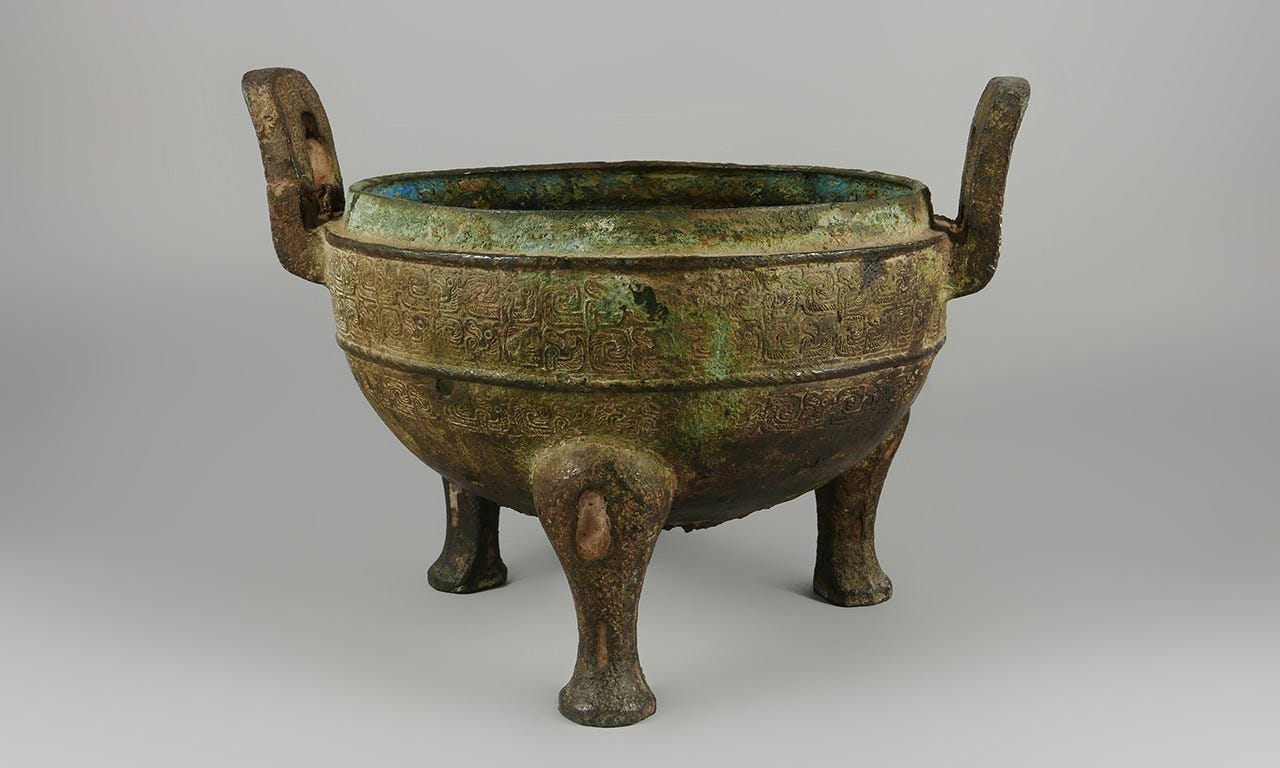
I share this to make a point; our collective ancestral bros figured out millennia ago that MUSCLE and STRENGTH was an adaptive response to lifting heavy objects
They didn’t know the molecular science behind hypertrophy, but they didnt need to. The fundamentals are unchanged through time; lift big, eat big, sleep deep, and growth will happen.
Muscle growth is a demonstration of the SAID Principle of Biology
Specific Adaptation to Imposed Demands
Muscle growth is an adaptive response. We have muscle because we live in gravity based environment, muscle enables movements.
When we lift weights, we are in essence increasing the force of gravity on our bodies. The specific adaptation to this demand is to grow BIGGER muscles in order to overcome it.
I was never a Dragon Ball Z watcher growing up (I discovered the show as an adult), but its worth mentioning because Gokus training in the Gravity Chamber is a perfect depiction of the aforementioned SAID Principle and “gravity loading” effect of weights
Thats the Big picture perspective, but lets examine the actual mechanisms.
These are hierarchal, and listed in order for most import to least important.
1. Mechanical Tension (The Primary Driver)
What it is: The force generated by the muscle fibers themselves to move a load.
Why it matters: This is undisputed as the number one factor for muscle growth.
When muscle fibers contract against resistance, sensors on the cell membrane (mechanoreceptors) detect this tension and convert the mechanical signal into a chemical signal for growth. This process is called mechanotransduction. If there is no tension, there is no signal to grow. You must lift heavy enough and/or close enough to failure to recruit and strain the high-threshold motor units.
2. Progressive Overload (The Practical Driver)
What it is: The gradual increase of stress placed upon the body during training over time.
Why it matters: This is the practical application of mechanical tension. We cant just lift heavy weights on time, or lift the same weight forever, we need to adopt a process of progressive resistance.
Because your body adapts quickly to stress, the tension that stimulated growth last month will not stimulate growth next month. To continue triggering the growth signal, you must progressively demand more; by adding weight, doing more reps, or improving technique to place more tension on the target muscle.
3. Neurological Innervation (Aka Motor Coordination aka The Mind-Muscle Connection)
What it is: The ability of your nervous system to consciously and forcefully contract a specific muscle group.
Why it matters: Every exercise you do requires neuromuscular coordination. You cannot create mechanical tension in a muscle without control. Noob trainees lack motor coordination, they cannot recruit high threshold motor units, and they do not have kinesthetic “feel” for the exercises they do, because this takes time to develop. In contrast, experienced trainees are much more coordinated, stronger, and their kinesthetic intelligence is more practiced. If you lack the “mind-muscle connection,” your body will compensate by using other, stronger muscles to move the weight. Developing this connection is a prerequisite for effective tension.
Dont sacrifice connection for weight: Weve all seen that guy in the gym whose modus operandi is to use as much weight as possible, with terrible form, and whose physique is underwhelming relative to how much effort he puts into hurling, heaving, jerking weight. Dont be that guy.

4. Range of Motion (Long Muscle Length)
What it is: Training a muscle through its full functional range, while maintaining joint position. AKA, a full range of motion
Why it matters: Real world results and scientific research all demonstrate that loading a muscle while it is lengthened produces superior gains compared to partial ranges or only training the shortened position. Full ROM ensures that all fibers are stimulated along their entire length, triggering the addition of sarcomeres (muscle units) in series.
How it Gets Messed Up: A recent trend of “strength mediated hypertrophy” is an example of scientific nonsense. Trying to over-emphasize the most lengthened/stretched position does NOT produce more growth. What does happen is muscles and joints being hyperextended, and eventual pain and injuries.
5. Time Under Tension (Duration of Stimulus)
What it is: The total duration the muscle fibers are under load during a set.
Why it matters: A single maximal contraction isn’t enough to signal hypertrophy; the tension must be sustained. While you don’t need to move in “slow motion,” you do need to perform enough volume (reps and sets) to ensure the fibers are exposed to tension for an adequate amount of time to fatigue them and trigger adaptation.
How many reps though? for practical purposes with safety, progression, and sustainability, a set should be at least 5 reps. The 1-4 rep range is very heavy and more of a TEST of strength versus a range you train in daily with an exercise.
6. Metabolic Stress (The “Pump”)
What it is: The accumulation of metabolites (lactate, hydrogen ions, inorganic phosphate) in the muscle cell, which can be exacerbated by doing higher reps, shorter rest periods, and manipulating tempo.
Why it matters: This is the biological cause of the “burning” sensation and the “pump.” When blood is trapped in the muscle (cell swelling), it threatens the cell’s integrity. The cell responds by reinforcing its structure (protein synthesis). While a distant second to tension, metabolic stress is a pathway for growth. When using anabolic steroids, this pathway becomes enhanced versus natural lifters
When to Rely on the Pump: For “Stubborn” muscles that are slow to grow, focus more on feeling tension and generating a pump (while still being mindful of progressive overload). This could be biceps, triceps, delts, calves, etc. Everyone has those muscle groups that need more reps, more TUT, and dont respond well to conventional 6-10, 8-12 straight sets.
7. Eccentric Damage (Muscle Breakdown)
What it is: Microscopic tearing of muscle fibers and the inflammatory response that follows, usually caused by the lowering (eccentric) phase of a lift.
Why it matters: Historically this was thought to be the main driver, but we now know that muscle damage is more of a side effect of tension than a direct cause. In fact, research has shown that the MORE damage that is caused in train, the LESS of a hypertrophy response. Some remodeling is necessary, but excessive damage (extreme soreness) can actually impair growth by forcing the body to use energy for repair rather than building new tissue.
What does all this add up to in PRACTICE?
We can condense this down to 4 primary strategies
-Lift heavy weights in the 70-85%, 5-15 rep range
-Add reps, or weight, or both over time. Train to get stronger
-Use good form through a relatively full range of motion, and feel the target muscles working
-Lift heavy, and also get a pump in the muscles you want to grow
The Workout is the Stimulus, and the Growth happens when you Leave the Gym
How to Determine if you Have GOOD Genetics (or not so good)
Get the Fitness Genes test, use code AJAC20 for 20% off
Stop guessing about what works for your body, and use your own genetic blueprint to guide you
Do you need to LOSE body fat? The Accelerated Fat Loss 2026 Challenge will start January 1st.