

Lets talk about your bowels and digestion.
When I first became a trainer, “gut health” wasnt something I paid much attention to. But I realized fast how COMMON it was that people would report they “bad digestion”, and these complants only increased over time.
As I learned, gut problems aren't some niche health complaint. If you look at the statistics, it makes sense how the concept of “Gut health” has become so widespread.
61% of Americans reported at least one gastrointestinal symptom in the previous week in a nationally representative survey of 71,812 U.S. adults. The most common were reflux/heartburn (30.9%), abdominal pain (24.8%), bloating (20.6%), diarrhea (20.2%), and constipation (19.7%).
A major Rome Foundation study of 73,076 adults across 33 countries found that 40.3% of internet respondents and 20.7% of household-interview respondents met diagnostic criteria for at least one disorder of gut-brain interaction. These conditions were also associated with worse quality of life and more doctor visits.
Nearly 18% of people globally experience bloating at least once per week. That comes from a 26-country analysis involving more than 51,000 people.
About 20% of Americans have GERD, according to the NIH/NIDDK.
About 16% of U.S. adults have symptoms of constipation, rising to roughly 33% among adults 60+.
A recent meta-analysis covering 96 studies across 52 countries estimated global IBS prevalence at about 14.1%.
The newest CDC figures estimate that 1.6% of U.S. adults have been diagnosed with inflammatory bowel disease, including approximately 3.1 million adults with ulcerative colitis and 1.3 million with Crohn’s disease.
A 2026 meta-analysis involving nearly 400,000 participants estimated celiac-disease seroprevalence at 1.5%, or roughly 1 in 70 people, with biopsy-confirmed disease around 0.8%, or approximately 1 in 120. Interestingly, about 41% of biopsy-confirmed cases were asymptomatic.
Gut Health is a BIG Problem
Ive seen people spend thousands of dollars trying to fix.
Im not a gastroenterologist. I dont have a magical answer to the root cause.
As a personal trainer and broscientist though whose worked with thousands of people online, I will say there are some very low hanging, strategic habits that people overlook in favor of more complex solutions.
People will buy a probiotic with 40 billion CFUs, dump it on top of a diet built around processed food, fail to drink water, ignore fiber intake, and then wonder why their digestion still sucks.
Gut health is not a supplement problem.
I remain unconvinced that supplements will do anything fundamental to fix poor digestion. Some of them might calm inflammation in the short term and give you space make changes, which is helpful (I like BPC+KPV for this purpose)
But long term you need to be able to EAT and have healthy bowel movements. Thats the functional definition of a healthy gut.
There are five things you should address FIRST.
1. Fix Your Hydration and Electrolytes
Ive shared this story many times, but over 15 years ago, one of my first training clients I ever had, he kept complaining about recurrent headaches, this came up in his first session.
I asked him how often he hydrated and drank water. He was surprised, thought about it, and said he doesnt really drink water, he mostly consumed coffee.
I told him to try drink 3 liters over the course of the day.
His headaches went away within a week.
Hydration has two parts
-How much water enters your mouth
-maintaining the right balance of water and electrolytes so your cells, nerves, muscles, and digestive system can function normally.
I suggest EVERYONE consume around 100 ounces of water daily.
What if thats TOO much? Then drink a bit less
What if thats not enough? Then drink more
The point is that you should drink water daily, in sufficient quantities. Figure out what that is. Drinking minimal to no water is NOT good for your health.
Your gut needs water for two basic jobs: maintaining the intestinal mucus layer and moving stool through the colon.
The bro bodybuilder practice of drinking a gallon a day is directionally useful and correct.
Then we have electrolytes
Sodium, chloride, potassium, and magnesium all matter.
And yes, electrolytes directly affect digestion.
Sodium is heavily involved in intestinal water absorption. Your intestines absorb sodium alongside nutrients like glucose, and water follows with it. This is the basic physiology that makes oral rehydration solutions so effective.
Chloride is also required to produce hydrochloric acid in the stomach. That does not mean eating more salt automatically increases stomach acid, but chloride is literally one of the raw materials your body uses to make it. Salting your food is GOOD for digestion.
Potassium and magnesium are important for nerve signaling of both your big superficial muscles, and smooth-muscle contraction. Like your intestinal tract, which is essentially a long muscular tube, that uses coordinated contractions to move food through it.
When electrolyte balance gets significantly disrupted (or is absent) motility can suffer.
Too little magnesium can also contribute to constipation. That said, too much supplemental magnesium can do the opposite, pulling water into the intestine and producing loose stools or diarrhea.
Potassium disturbances can also affect smooth-muscle function and intestinal motility.
This is why hydration and electrolyte status are connected to digestion.
If you’re training hard and sweating heavily, replace the electrolytes you’re losing.
This distills down to
Drink sufficient water.
Salt your food appropriately.
Eat potassium-rich whole foods.
Get adequate magnesium.
2. Eat Both Kinds of Fiber
Another thing I ignored for years.
“Fiber” gets talked about like it’s one substance, but there are in fact two (or three) different types.
Soluble and fermentable fibers can be metabolized by gut bacteria and these produce short-chain fatty acids such as butyrate, acetate, and propionate.
Butyrate is particularly interesting because colonocytes use it as an important energy source. Short-chain fatty acids also participate in signaling related to intestinal barrier function, immune regulation, and metabolism.
These types of fiber do FEED the gut microbiome and you should consume them regularly.
Good sources include:
Oats. Beans. Lentils. Apples. Psyllium. Chia. Flax. Certain fruits and vegetables as well, such as Kiwis.
Insoluble fiber contributes more to stool bulk and intestinal transit. This more often what people think of. They imagine the fiber of plants that can help with firm bowel movements.
This fiber comes from vegetable skins, leafy vegetables, nuts, seeds, and wheat bran.
I STRONGLY RECOMMENED STEAMING OR BRAISING INSOLUBLE FIBER FOODS FIRST
This is not an absolute rule, but its helpful. Ive made the mistake of consuming too much insoluble fiber at once, and now youre gut is torn up. Dont overdo the fiber, and breaking it down first with heat makes it more digestible in the first place.
There’s also an important caveat.
If fermentable foods consistently cause severe bloating, pain, diarrhea, or other symptoms, don’t conclude that fiber is inherently bad for you.
Something else may be going on.
That could include IBS, altered fermentation, food intolerance, constipation, or bacterial overgrowth. Symptoms alone cannot tell you which one.
This is where some people go carnivore, their symptoms disappear, and they assume they’ve repaired their gut.
Maybe.
Or maybe they simply removed the foods that were triggering the symptoms.
Those aren’t necessarily the same thing.
For most healthy adults, somewhere around 25 to 40 grams of fiber per day is a reasonable target. Build toward it gradually and get most of it from actual food.
3. Make Whole Foods the Default
This is the least exciting advice in the article and probably the most important.
Eat meat. Eat fruit. Eat vegetables. Eat potatoes, rice, oats, dairy, eggs, and other minimally processed foods that you digest well.
I am not saying to do an elimination diet, but eliminating the processed foods from your diet, TRY IT AND SEE WHAT HAPPENS.
You don’t need a named diet.
You need better ingredients.
Highly processed diets tend to combine refined carbohydrates, added fats, low fiber density, high palatability, and a long list of additives in a package that makes overeating almost effortless.
Some food additives, including certain emulsifiers, are also being investigated for their effects on the intestinal mucus layer and microbiome. The human evidence is still developing, Im not pretending that every emulsifier is intestinal napalm.
But regardless,
The simpler rule works better anyway:
The more of your diet that comes from recognizable whole foods, the fewer variables you have to worry about.
4. Consider Colostrum
Once the foundation is handled, bovine colostrum becomes interesting.
Colostrum is the first milk produced after calving. Compared with ordinary milk, it’s rich in biologically active compounds including immunoglobulins, lactoferrin, growth factors, and oligosaccharides.
The reason I’m interested in it isn’t because it’s some magical “superfood.”
It’s because there is human research suggesting bovine colostrum may help support intestinal barrier integrity under certain forms of physiological stress.
Exercise is one easy example.
Hard training, particularly prolonged exercise in the heat, can temporarily increase intestinal permeability. Some controlled studies have found that colostrum supplementation can attenuate markers of this response.
There is also experimental research looking at its potential protective effects against NSAID-related intestinal injury. (something Ive personally experienced)
That makes colostrum more interesting to me than randomly throwing ten probiotic strains into a dysfunctional digestive environment and hoping they establish themselves.
I generally think of colostrum as a supporting nutrient to use for a limited period of time, not something every human MUST take forever.
By itself, its still a very nutritious food, regardless of whether its for a specific health issue.
A practical trial might be 10 to 20 grams daily for three to four weeks, assuming you tolerate dairy proteins.
Then evaluate what actually happened.
Did bloating improve?
Did bowel movements improve?
Did food tolerance improve?
Did anything change at all?
Supplements should have a job. If they’re not doing that job, stop taking them.
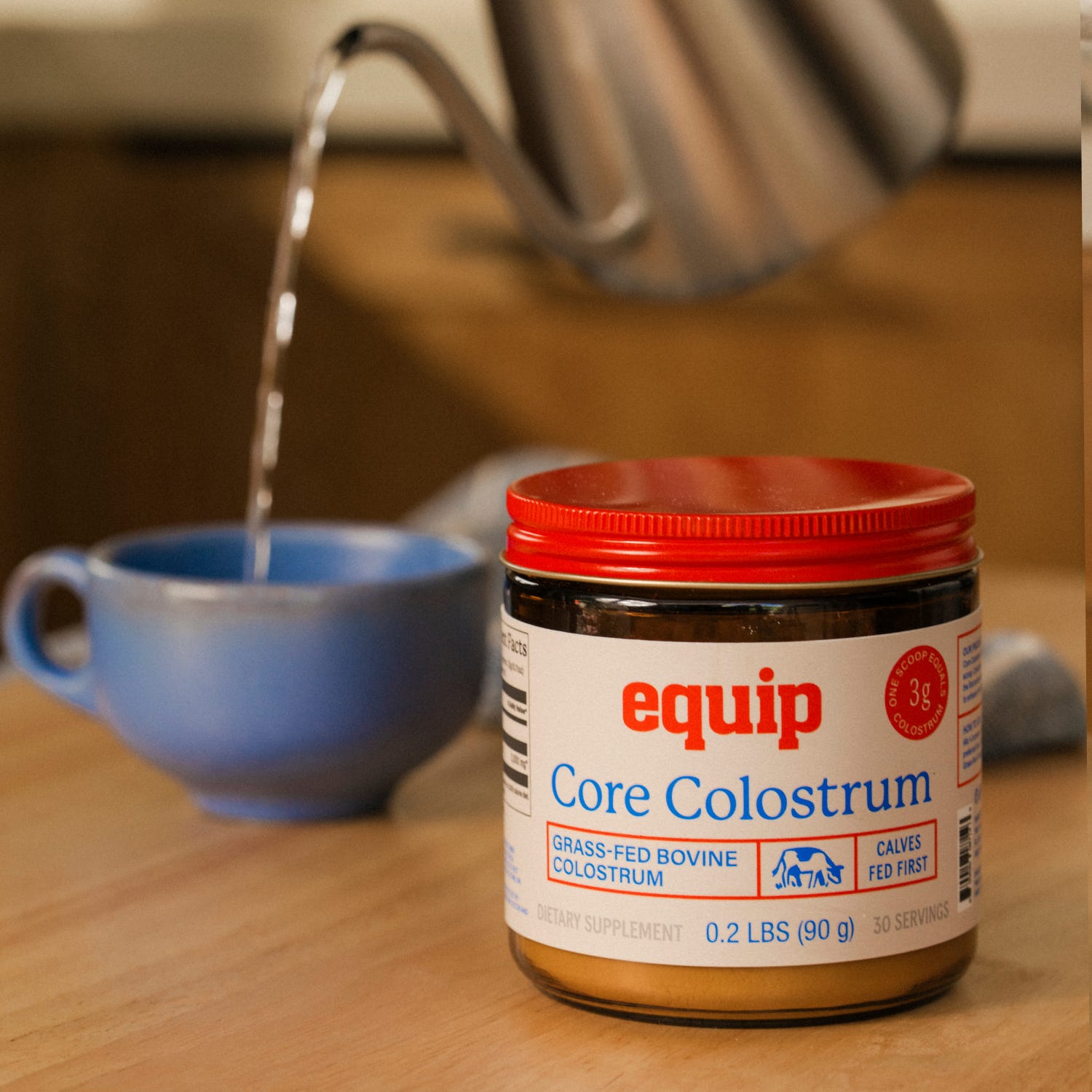
Equip Colostrum is a staple in our house for my wife after each of her pregnancies
5. Eat on a Schedule
Your digestive system likes predictability. So does your mind, and muscles, and all the rest of your body. Biology runs on timing. Entrainment is real.
Most people think digestion begins when food hits the stomach, but it actually starts before that.
The sight, smell, and expectation of food begin preparing the digestive system in advance. Saliva increases. Stomach acid and digestive enzymes are released. The gut starts getting ready for the meal it expects.
That process becomes more efficient when you eat at roughly the same times every day. Your body keeps a schedule.
If breakfast is usually at 8, lunch at 1, and dinner at 6:30, your digestive system begins anticipating those meals. You’re giving your body a consistent rhythm instead of randomly throwing food at it from the moment you wake up until the moment you go to sleep.
This works for another cool reason.
Between meals, the stomach and small intestine enter a fasting pattern called the migrating motor complex, or the MMC (sounds like a Marvel film)
This is the cleaning cycle so to speak of the digestive track.
Repeated waves of muscular contractions move residual food, secretions, and bacteria through the upper digestive tract. Eating interrupts that cycle and shifts the gut back into digestion.
This is the mistake of the Bro bodybuilder eat 6 times a day schedule. Not that most people are doing this, but for those that do, you never give your stomach a break. Its probably why modern bodybuilders are so bloated looking.
That aside, have regularly scheduled breaks from eating is GOOD.
The best approach is boring…
Eat three substantial meals at roughly the same times every day.
Leave around four to five hours between meals between meals.
And thats it.
You don’t need to obsess over whether lunch happens at exactly 12:32 every afternoon. The point is consistency. Your body should have a reasonably predictable feeding schedule instead of a sporadic and chaotic one.
Meal timing also wires in with your circadian rhythm. Digestion, glucose tolerance, gastric emptying, hormone secretion, and intestinal motility all follow daily biological rhythms.
That means when you eat matters alongside what you eat.
Ive come to prefer finishing my last substantial meal roughly three hours before bed.
Id suggest this to all of you as well, especially if you’re prone to reflux at night. Going to sleep with a stomach full of food is rarely doing your digestion any favors.
ALSO
Walk for 10 to 15 minutes after all your meals. I didnt think this deserves its own section. Walking after meals reduces blood sugar and improves digestion.
Eat. Digest. Leave your gut alone for a few hours. Repeat tomorrow at roughly the same time.
Run the Basics Before You Get Fancy
Give these five habits 4 weeks and see what happens.
Get your hydration and electrolytes right.
Eat enough fiber from whole foods.
Build your diet around whole foods.
Experiment with colostrum if you have a reason to use it.
Eat on a schedule.
Walk after you eat.
Then assess what improves for you.
After more than 15 years working with clients, I’ve watched people spend extraordinary amounts of money trying to solve problems that were being created by their daily habits.
Some people genuinely do need an expensive level of investigation and treatment. Persistent bloating, abdominal pain, reflux, constipation, diarrhea, blood in the stool, unexplained weight loss, anemia, or major changes in bowel habits deserve proper medical evaluation.
But for most people, FUNDAMENTALS FIRST.
Three months ago I started doing two things daily. 1. Taking a complete fiber supplement and 2. eating raw sauerkraut with my lunch everyday. I can honestly say that of all the diets and supplements I have tried over the years, these two things have made the biggest difference in my health and daily energy.
Excellent article, as someone who has had gut health problems for a good portion of my life.
Also, thank you for the reminder to drink water. After reading that, I grabbed my 40oz metal bottle (full of ice water) from the kitchen lol