

Shoulder Muscles were the “Man” Muscle before Pecs ever were
Before the Bench Press become the “bro” lift that every guy feels obligated to do, the foremost upper body lift was the ability to PRESS weight overhead.
This is funny to think about now, but up until the 1960s, the bench press was NOT that popular, and many gyms did not even have Bench press benches. To give some visual references, this is a replica of the Farnese Hercules (carved 1900 years ago).
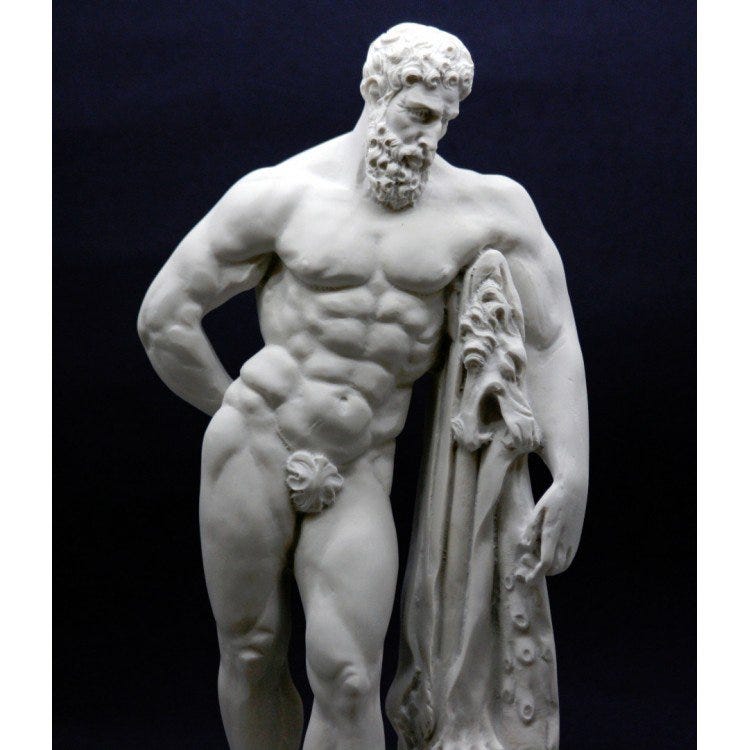
This looks embodies power:
-Incredibly muscular core
-Buffed legs
-Upper body, all the size is in the Shoulders and arms and lats. (Chest is actually not that developed in comparison.)
Here is another example in Eugene Sandow, most famous strongman to ever live.
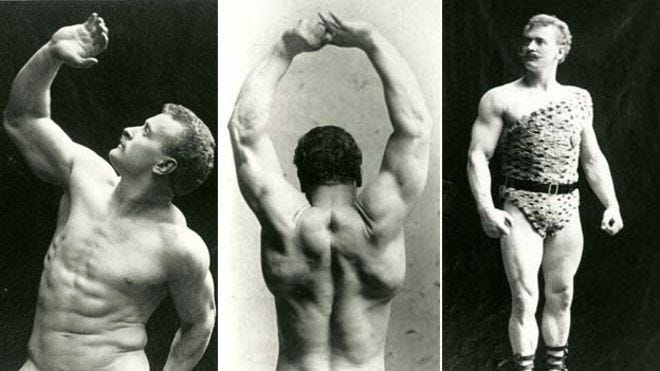
Sandow could press 300 lbs overhead, at a height of 5’9 and weighing about 200lbs, and this was in 1910.
His back is incredibly dense with muscle.
Chest though? He’d look puny next to a modern bodybuilder, despite being functionally stronger.
Alexander Karelin, arguably greatest Olympic Greco-Roman wrestler of all time.
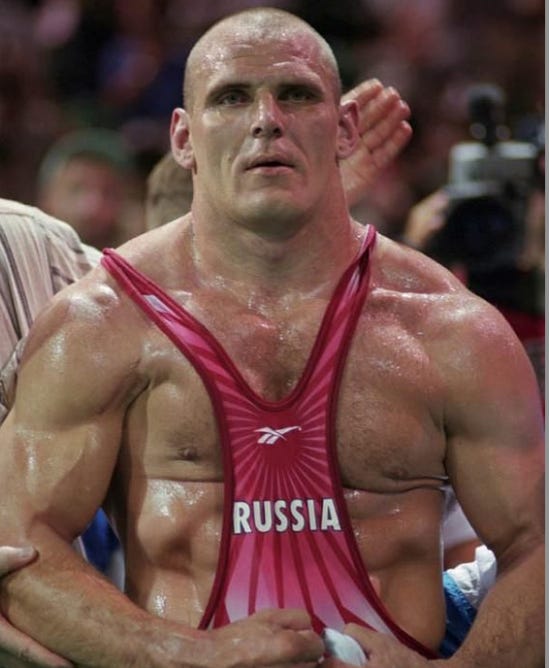
This man was a FREAK of nature, he could lift up 250 lb men and bodyslam them like rag dolls, he was feared in the wrestling world for almost two decades and was unbeaten for over 10 years.
Look at the chest development compared to the shoulders and traps.
Chest was not where he got his “power” from.
Until Arnold came along, having massive pecs was not a common look. Many old time strongmen and even classic age bodybuilders considered it odd-looking to have an overdeveloped chest.
Now, that does not mean that you should not train chest, but historically it was innately recognized that in regards to both aesthetics and function, the deltoids were the key muscles.
In the first half of the 20th century, the Gold Standard for Upper Body strength was a Standing Shoulder Press (barbell press) with your Bodyweight
This standard has largely been lost. Very few men shoulder press heavy in gyms anymore. Training for overhead strength is a slower process than training say the chest, and the bench press is the new gold standard lift.
Regardless, when it comes to athleticism and being able to tackle, throw, grip, stiff arm, and punch, the power is in the SHOULDERS. Getting big and strong shoulders requires more athletic ability than bench pressing does.
When you bench press, the bench is stabilizing your body. Yes, this still requires muscle mass and you can move massive weights, but the bench press has obvious setup advantages for stability.
Compare that to the overhead press, and any kind of “inclined” press. When you tackle someone, throw a punch, go for a takedown, or pick someone up for a slam, that doesn’t just require shoulder and arm strength, it’s total body strength from head to toe. There’s no bench to stabilize you. If you’ve got a weak core and weak upper back and no traps and no lats, you won’t be able to press shit.
The two “old school” chest and shoulder exercises for years were DIPS and Shoulder presses.
And pressing overhead requires total body strength far more than bench press as well.
Functionality emphasized, there is also the AESTHETIC factor.
What is it about having wide shoulders that impresses people so much?
Crafting the Ideal Body-The Grecian ideal
Beauty and form in biology are entirely mathematical. Everything in the natural world follows the same Constructal Laws of Biology.
This form follows certain mathematical properties, specifically, what is known as the Golden Ratio, or the Golden Mean.
This ratio is a universal proportion that is found across the entirety of nature. Everything from seashells to DNA to the orbits of the planets around the sun follow it.
Relative to the human body, the golden ratio determines symmetry and beauty. Beauty is mathematical, as is body structure.
And beauty is not just “appearance.” Men and women whose body are more symmetrical and more closely follow the ratio are healthier, smarter, more fertile, and live longer.
Greek Statues are well known examples of the Golden ratio. If you have ever wondered why they are so timeless looking, it is because they were purposefully carved according to this Golden Mean.
The Greek created the study of aesthetics and form, and these were not “socially constructed” as some would argue.
The Greeks keenly observed that beauty followed the same patterns, regardless of whether it was the body, buildings, or the petals of a flower.
The Golden Mean is expressed as 1.618.
Mathematically, the concept is fairly simple:
Two measurements comprise the Golden Ratio if the ratio of the sum of the measurements to the greater measurement is equal to the ratio of the greater measurement to the lesser measurement
And said without math at all, it means that two things have the same proportions of size, and that proportion always repeats itself.
You can see the Golden Mean in Greek Statues. There is a reason they are so aesthetically appealing. It is not random.
This statue does not look attractive by accident. It follows the Golden ratio.
Like the Shoulders are quite obviously MUCH wider than the waist.
Applying the Golden Ratio to the Body, and to the Shoulders
For men, applying the ratio is easy. It is sometimes called the “Adonis Index Ratio”. Credit to Brad Pilon and John Barban for the term.
You measure your waist, and then measure your shoulders. You measure your shoulders by going around your pectorals, around the widest part of your delts, and and your upper back.
Your shoulders should be 1.61 times larger than your waist. This generally works out to about a 20 inch different.
28 inch waist-48 inch shoulders
29 inch waist-49 inch shoulders
30 inch waist-50 inch shoulders
31 inch waist-51 inch shoulders
32 inch waist-52 inch shoulders
So on and so forth.
Now, if you have a 38 inch waist, and 44 inch shoulders, you’ve got A LOT of work to do.
However, you’ve also got a VERY objective measurement you can follow:
Lose the bodyfat, build the upper body muscle, and you can improve your looks substantially. Looksmaxxing, as the young people say.