

The ONE THING You Need to Understand about the Shoulder Joint
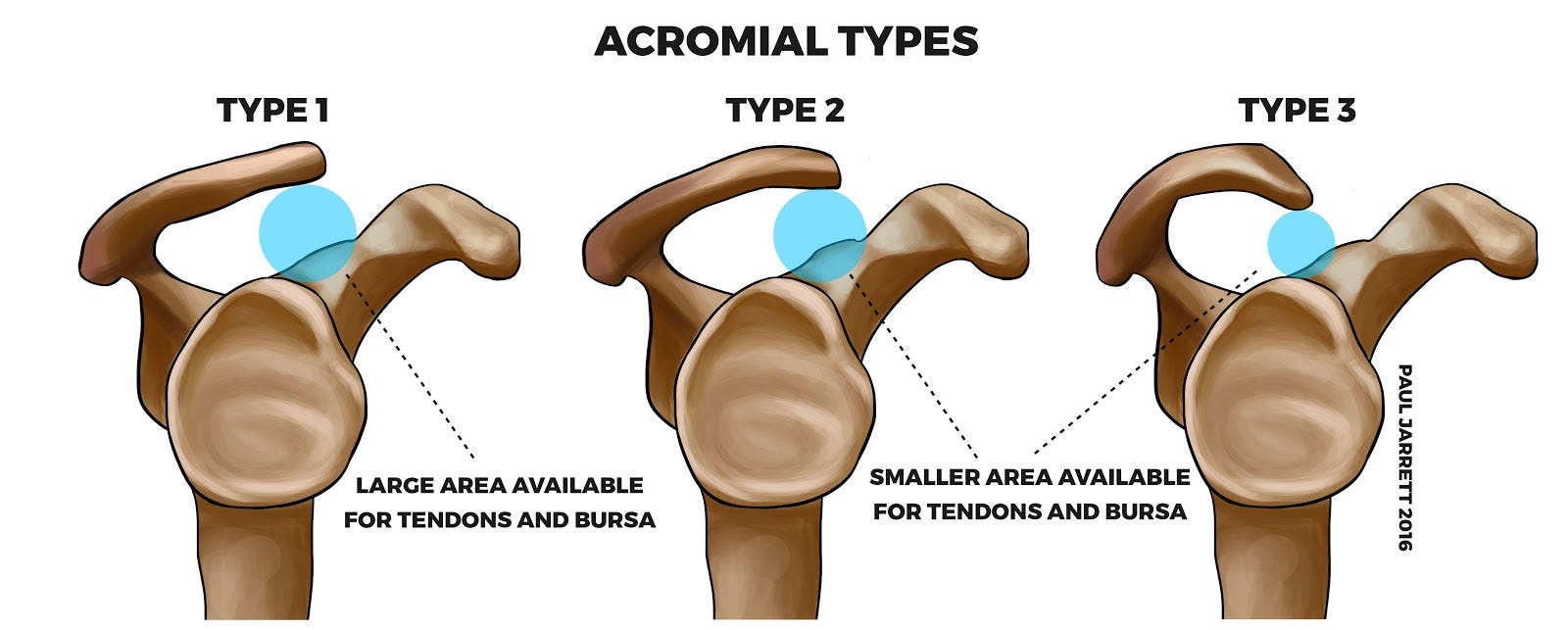
See this photo? It show the different kinds of shoulder joint BONE shape.
(No copyright infringement is intended in the use of this photo. This was taken from the web, not something I made.)
There are three (and sometimes 4) general but distinct categories of Acromion Morphology
Type 1-This shoulder has a flat shape and roomy space for tendon and bursa to fit into
Type 2-This shoulder has a smaller area for tendon and bursa to fit into, and may be more prone to feelings of impingement
Type 3-This shoulder has an ever smaller area for tendon and bursa to fit into, the beaked shape of the bone leads to compression and extra wear and tear into the rotator cuff tendon and more pressure on the bursa
Type 4 (not show)-An uncommon shape, the acromion will have a convex shape and extra space.
Why does this matter?
Because the less joint capsule space you have in your shoulder, the more likely you are to experience shoulder impingement with exercises, and the faster the joint can break down.
It affects exercise selection and performance
If you’ve got the type 1 structure, you can shoulder press and bench press and it will feel GREAT. You are unlikely to have issues with traditional barbell lifts and pressing.
If you’ve got Type 2 structure, Bench pressing might be fine, but shoulder pressing might hurt if you go too heavy, and your shoulders may be more prone to aggravation.
If you’ve got type 3 structure, overhead pressing can be immediately uncomfortable . You might be able to do a high incline kind of pressing, but overhead pressing will automatically cause impingement and make your shoulders feel crunchy.
How do you you know which one you are?
Barbell Overhead Press
Take the empty barbell and press it overhead.
If you can do this easily with no leaning back, no impingement, and can easily lock out the barbell, with it literally going straight up and it feels good, you’ve probably got type 1 shoulders.
If you have to get some lean back going, and you can lock out the elbows, but if feels like you cannot fully straighten the shoulder in the socket without some crunch, then you’re moving more towards type 2.
If you have to lean back A LOT, your shoulders definitely feel impinged, and you cannot fully lockout the movement and the joint feels impacted and you ran out of space, you’ve got type 3.
I myself have a Type 3 Acromion on my left shoulder. Because of it, I’ve had two AC Joint Separations, and when I should press, I can only press on a high incline angle. Trying to press straight overhead automatically causes impingement and I cannot lock out my left arm at all, because the humerus runs into the acromion and the joint has no space left.
This is Why People Get Different Results With Shoulder Training
When you factor in musclebuilding genetics, you get a range of outcomes.
You don’t need to get assessed by a personal trainer necessarily to figure out what your body responds to, you can use your own biofeedback and results from training.
Shoulder Genetics generally fall into three categories:
1. People who can simply overhead press, and they get great development
-These are the same people who are typically excellent at the bench press as well. They are men (or women) with larger bone structure, thicker joints, larger tendon attachments, and the kind of genetics where they can simply do the basic movements, and this works for them, and they don’t have much need for anything else.
These people are typically the strongest people, but also the WORST at giving training advice. Because they’ve never struggled much to build muscle or strength and have followed a basic approach, they tend to be very dogmatic about “hammering the basics”, and that all you need is the Big 3 and maybe some chinups and dips.
If you are one of these people, you’d already know it.
2. People who are okay at OH pressing, but need isolation work
-This is most people. Its uncommon to find people that are exceptional at overhead pressing. Most people, their shoulder pressing strength is the slowest to develop next to their bench, squat, and deadlift. The shoulder is a delicate joint, and it requires a great deal of reinforcement to grow and get stronger.
A mixed approach of moderate to high reps and compound and isolation exercises works best. I’ve found that training with higher reps can produce substantial growth in people, as it fatigues the smaller muscles fibers and entrains proper patternization.
3. People who can’t OHP, require isolation, any OHP (if any) is done light to moderate
-Now, it occasionally happens that some people simply CANNOT overhead press safely. Due to their structure, injuries, etc, it’s not worth the risk.
For these people, almost all of their shoulder work is done as isolation movements.
And this can actually work phenomenally well.
Shoulders are the one “big” muscle that you can build almost entirely with isolation exercises, and get equal or even better results than using compound movements.