

This was a stream of conscious post written in one go.
before we start
Broscience Approved Sponsors
Elite research USA. If youre a broscientist researcher, check out their catalog. Peptides, bioregulators, unique formulations, theyve got it all. Use code AJAC10 for 10% off.
High Tech Health Sauna-I will never stop being a sauan evangelist. Sweating purifies the body, blood, and soul. Get one and cleanse yourself. Mention AJAC on the phone for a deal
Velocity Health. I started a company that I know will require 10 years to turn into a success. I contacted them in January to manage my health throughout that process. I do in fact believe in having a concierge doctor (if you can afford it)
When I got into lifting weights, it was around 2005, and the dominant online influence was from the powerlifting world and hardcore bodybuilding.
The “science” around lifting could be considered primitive compared to today. True broscience theories based on nothing but personal anecdotes abounded.
Since that time, hundreds of studies have been the past 20 years on strength and hypertrophy training.
But if you were to ask me whether any of them have fundamentally changed what we know to work…Id say no.
If we go back in time…
There was no “online media” beyond message boards.
Westside Barbell was at its peak, as equipped powerlifting meets were the only strength sport that you could find on the internet due to people taking videos and pictures. An early lesson in the power of media in shaping belief and perception.
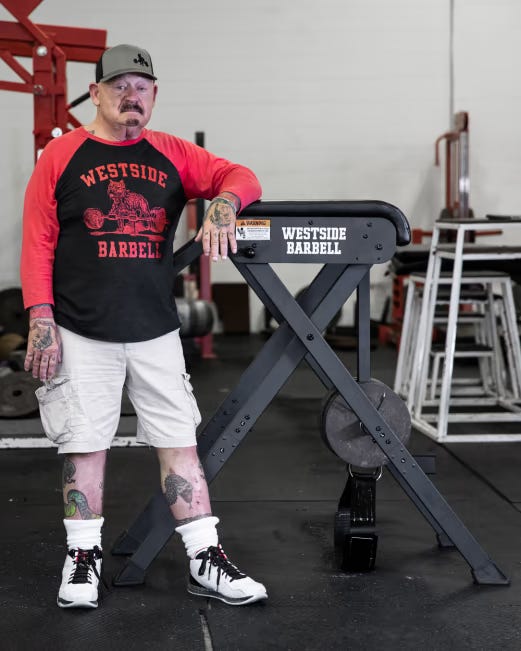
Does anyone do “dynamic effort” day anymore?
Now, if you werent into powerlifting, you of course had bodybuilding and the muscle magazines for articles.
Videotapes of the top bodybuilders could be purchased through muscular development.
These videotapes are now on youtube, and they are golden to watch.
This is all to say that the dominant philosophies at the time were either
1-Powerlift, Big 3
2-Bodybuild, high volume, lift heavy weight and go to failure with reps
There was also a hybrid of the two…
POWERBUILDING.
This was most identified to Metroflex Gym (home to Ronnie Coleman, Branch Warren, and Johnnie Jackson").
The gym was legendary even then, owned by Brian Dobson in Arlington, Texas, and it was resident trainer Josh Bryant who pioneered the powerbuilding philosophy.
Looking back on it…its held up. There is nothing about it that can be said to be wrong by modern exercise science standards.
If anything, exercise science has proven to be a largely ridiculous field respective to Strength and hypertrophy training.
After decades of research and a Rise in “Science based lifters”, weve been left with the same practices and training strategies.
Core Powerbuilding Principles
1. Heavy Compound Movements: The foundation emphasizes lifting heavy weights on core exercises like squats, deadlifts, bench presses, overhead presses, chin-ups, and bar dips.
-The overall global muscle growth gains from these is still indisputable.
2. Progressive Overload: the second cornerstone of the training philosophy, requiring consistent increases in demands placed on the body over time.
-Nothing to argue about here either
3. Volume Training: Sessions typically include multiple exercises per muscle group with several sets and reps to fully exhaust muscles and stimulate maximum growth. Split routines focusing on different muscle groups on different days allow for both intensity and recovery.
-The low volume and HIT crowd will always argue about sets, but considering how many physiques its built, its a stupid argument. Moderate to high volume training clearly works for most people, provided you eat enough and sleep well.
4. Balanced Exercise Selection: The approach balances high reps, low reps, fast reps, slow reps, compound movements, peak contraction exercises, free weights, and machines
-Yes, you can do multiple rep ranges in the same workout. You can a barbell movement for low reps, say 5-8. Then do dumbbells or machines for sets of 8-12. Then maybe some cables for moderate to high reps. No one is stopping you. You can even use multiple kinds of resistance. You dont have to choose between free weights, machines, and bodyweight.
5. “No Pain, No Gain”: Training to failure and beyond is common, with discomfort embraced as a sign of effective training. This intensity-driven approach, combined with discipline to repeat it for years without deviation, separates champions from average lifters.
-This is another point that people argue about, such as Reps in Reserve. I consider RIR to be a bullshit principle based on bullshit reasoning. On any given day, your ability to give 100% to a training session will fluctuate. Intensity drives adaptation, and rarely has anyone lacked results from training TOO hard. “I worked out too hard with too much focus, and my muscles didnt grow”…this is not a widespread problem. Maybe amongst a small subset of hardcore lifters who do too much junk volume, but that is a scarce group. When in doubt, train to failure, or at least very close to it.
Part of the Appeal of someone like Sam Sulek is the fact he trains HARD
I dont watch Sams videos, Ive only seen clips. What I have seen, Ive been impressed by. Hes earnest, thoughtful, and his training intensity is undeniable.
Sam does NOT obsesses over angles, moment arms, and “optimization”. He trains like a golden age bodybuilder, and LOOKS like one.
After the past decade of optimal exercises, optimal workouts, optimal schedules, optimal macros, optimize everything…so much of is pedantry. Majoring in the minor and the inconsequential.
When in doubt, lift heavy, lift hard, use all the reps ranges, and get a sick fucking pump.
This is basically what I do.
I don't care about being THE strongest at any lift, but I do want to be strong. And I want to look good.
And so I have a powerbuilding routine that mostly follows what this article lays out. Great stuff!