

This article is for educational purposes only. The compounds discussed are not approved by the FDA for diagnosis, treatment, cure, or prevention of any disease. References to scientific studies are presented in a research context only. Nothing here is medical advice or encouragement for personal use.
Thymosin Alpha 1
I’ll be honest, I never thought much about the thymus gland until the past few years. Its not an organ that gets much emphasis in regular education, if it is brought up at all. Name major organs and you think of the Heart, Brain, Lunges, Liver, Kidney…unless you are a biology or Pre-med major of some kind in college, its doubtful you have even heard of it.
It wasnt until I became a dad, had kids, and experienced the stereotypical “my kids sneezed into my eyeballs and got me sick” that I started caring about boosting my immune system.
And by boosting, I wanted REAL improvement.
More than the conventional sleep, diet, exercise, lifestyle. While the foundational habits are important, its beating a dead horse to say they matter. Of course they do. But what else could be done?
I already knew about IV therapy, and I was curious what the peptide world had to offer. I also had to research what makes the immune system “Strong” in the first place. How do we define that?
That brought me to the Thymus.
It took medicine a long time to figure out that this fading organ drives the entire immune system, and its steady shrinkage (Thymic involution) corresponds with aging, susceptibility to disease, and eventually death.
The thymus produces two essential components of the nervous system
-T-cells, which start out as immature thymocytes. These T-cells are “trained” so to speak in the Thymus to respond to foreign antigens and become effective immune system soldiers
-Thymosin Alpha 1 (Tα1), a peptide so fundamental that evolution stamped it ‘do not edit.’ Its produced across all mammalian species, a master key that regulates the entire immune
Lets start with the basics though of WHEN it was discovered, and then we get into the details of its effects.
The Beginning of Thymosin Alpha 1
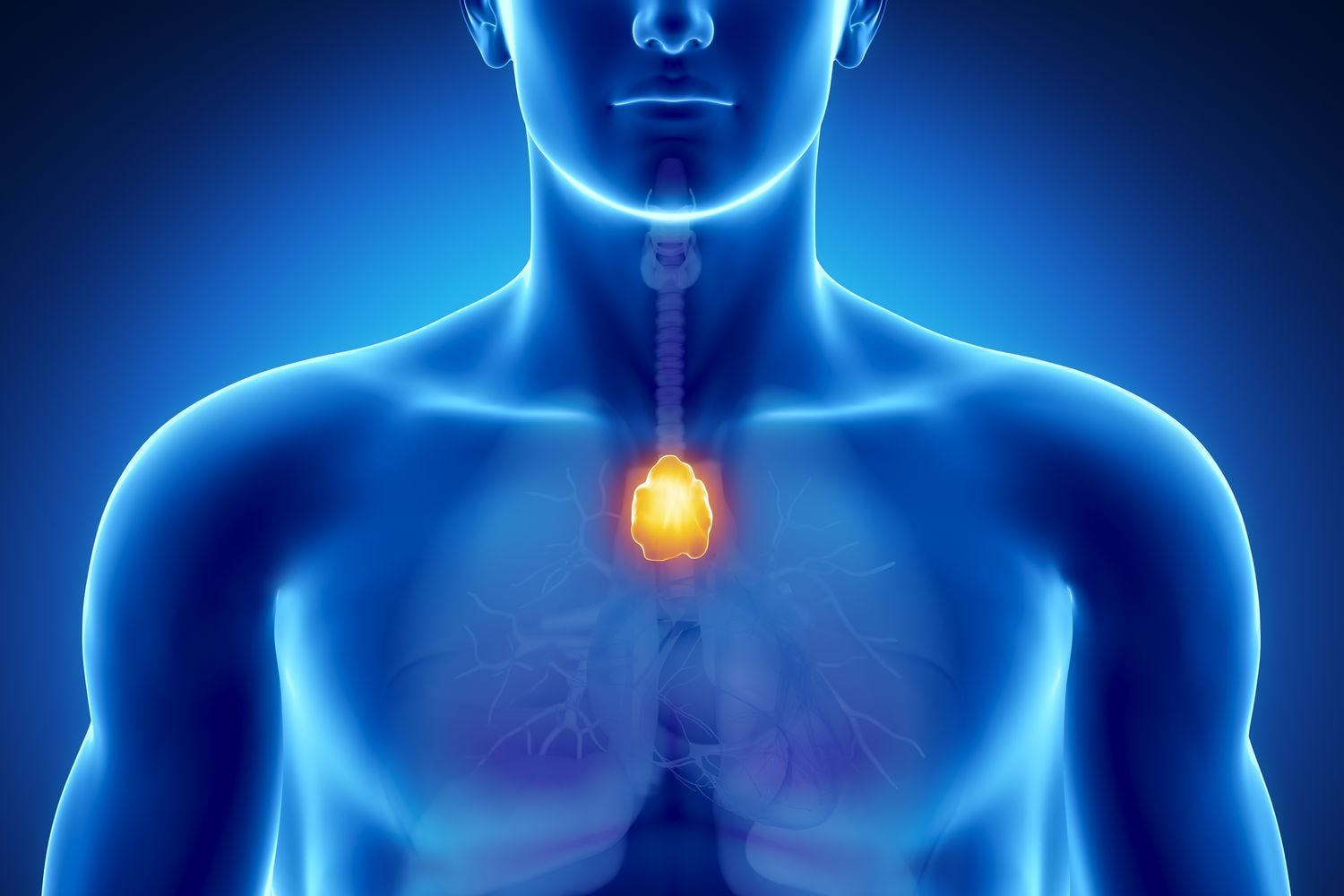
The Roman Physician Galen first described it almost 2000 years ago (in animals), and it was discovered to also exist in people by dissecting corpses. For centuries, anatomists described the thymus as a soft, lobed triangular gland behind the sternum. But they had no real clue what it did. It grew in children, shrank in adults and was mostly dismissed as vestigial.
That assumption began to collapse in the 1960s and 1970s, when scientists realized the thymus was actually the training ground of the immune system. T-cells, the very white blood cells that orchestrate defense against infections and cancers, mature inside this unassuming organ.
The thymus was not useless.
One of the pioneers in this rethinking was Allan Goldstein at George Washington University. Goldstein suspected that the thymus was not just a staging ground but a chemical factory, producing signals that shaped the immune system itself.1
His lab began grinding up calf thymus glands, fractionating the proteins, and searching for the molecules that carried the “immune code.” Out of this messy extraction work, a family of small peptides called thymosins emerged.
Structure and Basics
Thymosin Alpha 1 is a peptide. It’s short, modest at just 28 amino acids long, clipped out of a much bigger parent protein called prothymosin-alpha. Whereas Prothymosin-alpha predominantly works inside cells, particularly in the lymphatic system, Thymosin Alpha 1 works outside of them. 2
The bigger protein does a lot inside the cell, but this little piece, Tα1, is the part the body actually uses as a messenger that goes around all the body’s tissue signaling them to active and organize an immune system response. It’s copy-paste biology, in the sense its the exact same sequence in humans, mice, and a long list of mammals. When nature refuses to edit something for hundreds of millions of years, it usually means you’re looking at a master key.
A “master key hormone” is a term often used to describe a peptide or hormone that exerts major, overarching regulatory effects on multiple systems or critical biological processes
It’s also water-soluble and stable enough to be manufactured synthetically, which is why companies like SciClone were able to bottle it as Zadaxin, the prescription version approved in over 30 countries. 3
And no, it’s not the same thing as thymosin beta peptides (like TB-500 or thymosin beta-4). While TB500 also comes from the Thymus, its an even smaller peptide (only 7 aminos in length), and it effects are more specific to tissue repair. Tα1 effects are much more broad. If you imagine your body as a fortress, TB-500 is the carpenter fixing walls and beams, while Thymosin Alpha 1 is castle manager coordinating everyone to do their jobs.
How Thymosin Alpha 1 Works: Immunomodulation
Thymosin Alpha 1 core function is Immunomodulation (T cell function). The immune system operates on a body wide network of receptors being carefully stimulated. These receptors function like locks and key. The locks are receptor sites, the keys are peptides and proteins. When the key fits into the lock, a function, process, system is activated. When everything works perfectly, those receptors pick up danger and kick off the right alarms at the right times. But as we age or when stress and illness pile up, those alarms don’t always work like they should. Sometimes, they go quiet, sound too late, or just send static.
That’s the role of Tα1. Its role as an immunomodulator is turning on the these signals, at the right times. When it clicks into specific receptors (especially TLR-2 and TLR-9)4, it fine-tunes the signal. Instead of noise, the immune system gets a clear instruction sheet. Interferons, the body’s antiviral sirens, will surge. T-cells multiply and sharpen their targeting.
The immune system is complex, and science doesnt fully understand it. At any given time, your body is coordinating a vast network of cells that target foreign pathogens, regulate internal microbiomes, kill off dead cells and rogue cells, clean up tissues, and fix damaged areas. This happens 24/7/365.
That’s the role of Tα1, coordinating all of this in tandem. Take it away, and the entire system doesnt fully operate as it should.
Mechanisms of Action
T Cell Maturation and Differentiation: Tα1 promotes the maturation of precursor stem cells into functional CD4+ and CD8+ T lymphocytes, helping balance populations of helper and cytotoxic T cells
Stimulation of Natural Killer (NK) Cells: Tα1 directly activates NK cells and cytotoxic T lymphocytes, increasing their ability to recognize and kill virally infected and malignant cells
Dendritic Cell Activation: Tα1 primes dendritic cells (DCs) via Toll-like receptors (TLR2 and TLR9), which amplifies antigen presentation and triggers stronger T-cell responses
Cytokine Modulation: Tα1 increases production of key cytokines (e.g., interferon-gamma, interleukin-2, interleukin-12) that favor Th1-mediated immunity, while downregulating inflammatory cytokines like IL-4 and IL-10, shifting the immune milieu toward enhanced pathogen clearance
Upregulation of Antigen Presentation: Tα1 increases the expression of MHC class I molecules and tumor/viral antigens, making target cells more visible to immune surveillance and better equipped for pathogen and tumor eradication
Direct Modulation of Immune Gene Expression: Tα1 activates intracellular signaling pathways including NF-κB, MAPK, and TRAF6, leading to upregulation of genes responsible for major histocompatibility proteins, cytokines, chemokines, and costimulatory molecules
Protection from Immunosuppression: Tα1 antagonizes corticosteroid-induced lymphocyte apoptosis and reverses immunosuppression, restoring immune homeostasis after stress or treatment-related immune impairment
Promotion of Viral and Tumor Antigen Visibility: By increasing antigen expression on infected or transformed cells, it enhances their detection and destruction by cytotoxic cells
These effects were not all discovered at once, this happened over decades. But a picture steadily emerged that not only was the Thymus essential and Tα1 powerful, but it also held promise for anti-aging and longevity medicine. If thymus shrinks with age, and Tα1 output along with it, then perhaps increasing Tα1 and halting the shrinkage could extend healthspan and lifespan . 5
The Medical Footprint of Tα1
After Tα1 was identified in 1979, it did not sit on the shelf and get stuck in limbo the way some peptides do. It caught researchers attention and by the early 1980s, clinicians were testing it in patients whose immune systems were under strain.
One of the focuses was viral hepatitis, especially hepatitis B and C 6, where adding Tα1 to standard treatments often led to stronger T-cell activity, better interferon responses, and in some cases, lower relapse. It wasn’t a cure, but it consistently tilted the odds in the right direction.
Cancer researchers soon tried it as an adjunct, reasoning that if tumors survive by dampening immunity, Tα1 might help flip the switch back on. Trials in melanoma, lung, and breast cancers showed mixed clinical results but a consistent pattern: immune markers improved, patients tolerated it well, and standard therapies sometimes worked better alongside it.7
By the 1990s, the peptide was licensed in parts of Asia and the Middle East, particularly as a support for hepatitis. Around the same time, vaccine studies found another role. Older adults and immunocompromised patients often failed to respond to hepatitis B shots, but pairing the vaccine with Tα1 boosted success rates.8
That use case is still a reason it remains on formularies today.
Decades later, the same logic resurfaced during COVID-19. Doctors in China used Tα1 in severe cases, not to fight the virus directly but to revive exhausted immune systems. Early reports suggested lower mortality, though large-scale trials never caught up to the pandemic’s pace.9
Proposed Benefits In Practice
In the USA, Tα1 is approved as an Orphan Drug for a limited number of use cases. Despite this, most visions of have never heard of it, despite it being tested in a surprising number of arenas. Here’s the short tour:
Infections: From chronic hepatitis B and C to HIV and even COVID-19, Tα1 has shown it can improve recovery outcomes. Patients clear viruses faster, antivirals work better, and the immune boosting effect is real.
Cancer: In chemo or immunotherapy trials, it sharpened T-cell responses, steadied immune markers, and sometimes helped standard treatments work more effectively.
Sepsis: When sepsis pushes the body into “immune shutdown,” Tα1 can help with revitalizing. Early data suggest it helps wake defense back up, reducing the slide into secondary infections.
Autoimmunity: Still early days, but researchers are testing whether Tα1 can calm an immune system that’s gone rogue. The promise? Dial down inflammation without the collateral damage steroids bring.
Prophylactics and Longevity : In biohacker circles, it’s popular for two simple reasons: it keeps you from getting sick. And if you are sick, you recover faster.
So are we talking a capsule or a pill?
Thymison Alpha 1 is an injectable peptide, although it sometimes used in a nasal spray (less common, and less proven). Historically, the injectable version is what all the research has been done on
Subcutaneous Injection: This is the classic medical route. Doctors and hospitals use it, and if you’ve seen “Zadaxin” prescribed overseas, this is what they’re talking about. The peptide comes in tiny vials, usually 1.6 mg or 3 mg, and gets pinned just under the skin with an insulin-sized needle.
Compounding Pharmacies: Outside of official prescriptions, you’ll see Tα1 made by US compounders. Clinics in the anti-aging space and biohackers in forums use these a lot. Thymosin Alpha 1 is also readily available as a research chemical, although this is obviously not intended for human usage.
Intranasal Sprays: This one’s more experimental. Instead of injecting, the peptide is atomized and sprayed into the nose, aiming for mucosal immune tissue in the airways. The logic: your first line of defense against viruses is in your nose and throat, so why not deliver it there directly? No formal trials yet, but the ease of use makes it popular with DIY circles.
Safety and Tolerability
Tα1 doesn’t come with a laundry list of warnings. Most published trials use subcutaneous injections in the 1.6–3 mg range, given a few times per week over weeks to months.
But because it’s not fully FDA-approved, there’s no standardized schedule in the US, and compounding pharmacies and private practice physicians may vary in dosage recommendations.
Contraindications are rare but worth noting: people on immunosuppressants (like transplant patients), those with autoimmune flare-ups, and/or anyone stacking multiple immune-active drugs should tread carefully.
There’s little data on drug–drug interactions, but because Tα1 tunes immunity, it could theoretically blunt or amplify other therapies.
That said, while no medicine can be called side effect free, it is exceptionally safe overall in most circumstances. Tα1 has one of the cleanest resumes you’ll ever see for safety. Considering its been used in cancer patients, chemotherapy patients, and individuals with compromised immune systems, it does not appear to have any obvious side effects outside of the above. Like many peptides, at worst it simply does not help. At best, it might be a gamechanger for health. 10
It’s safe enough that more than 30 countries have given it a seal of approval and its prescribed. So why not the US?
Per usual, the the answer isn’t science or safety, it’s money. Tα1 is a natural peptide, it which means you can’t lock it behind a billion-dollar patent wall.
Pharma saw no jackpot, so the FDA saw no rush. It’s not danger keeping it off American shelves, it’s lack of dollar incentives.
Approved: Over 30 countries, including China, Italy, and parts of the Middle East, for hepatitis, cancer adjuvancy, and vaccine support.
Not approved: United States, Canada, UK, Australia, here it’s research-only, often ordered through compounders
Gray zones: Some countries allow hospital use during outbreaks (SARS, COVID-19) under emergency provisions.
Tα1 is safe, but the infrastructure around it is uneven. The science paints it as an immune tuner, but the logistics (sourcing, purity, and regulation) decide whether you’re looking at a hospital-grade tool or an experiment.
How Biohackers and Bros Use Tα1
How Tα1 actually gets used:
Overall Immunity: This is the quiet lane. Regular low dosing keeps immune responses sharper, so small hits like jet lag, work stress, and minor bugs don’t turn into full wipeouts.
Seasonal armor: One or two doses a week through cold season, and you’re the guy who keeps training while everyone else is hacking up lungs. It’s subtle until you realize you’re the only one not sick.
Injury stacks: TB-500 and BPC-157 are great at telling the body to patch up torn muscle or tendon, but they don’t cover the full picture. Healing burns resources, and that’s when your immune system can slip. Adding Tα1 is extra support.
Post-cycle clean-up: When you come off a heavy run of compounds, your immune system’s usually in the gutter. You’re tired, cortisol’s high, and little stuff, sinus infections, chest bugs… can wipe you out. This is where Tα1 gets pulled in. Guys will run it for a few weeks after their PCT alongside the usual support (NAC, Tudca, sleep hygiene).
If you want to actually see how people are running it, join my biohacking circle. For those working at the research level and chasing purity, I point them toward Elite Research USA for research grade Tα1 (affiliate code 10AJAC still gets 10% off).
References:
“A Life-Saving Discovery | GW Today | The George Washington University.” GW Today, https://gwtoday.gwu.edu/life-saving-discovery. Accessed 25 Sep. 2025.
Dominari, Asimina, et al. “Thymosin Alpha 1: A Comprehensive Review of the Literature.” World Journal of Virology, vol. 9, no. 5, Dec. 2020, pp. 67–78. PubMed Central, https://doi.org/10.5501/wjv.v9.i5.67.
https://www.sec.gov/Archives/edgar/data/880771/000088077105000008/form10-k.pdf
Sameer, Aga Syed, and Saniya Nissar. “Toll-Like Receptors (TLRs): Structure, Functions, Signaling, and Role of Their Polymorphisms in Colorectal Cancer Susceptibility.” BioMed Research International, vol. 2021, Sep. 2021, p. 1157023. PubMed Central, https://doi.org/10.1155/2021/1157023.
Palmer, Donald B. “The Effect of Age on Thymic Function.” Frontiers in Immunology, vol. 4, Oct. 2013, p. 316. PubMed Central, https://doi.org/10.3389/fimmu.2013.00316.
Liang, Yong-Rong, et al. “Thymosin Α1 Therapy Subsequent to Radical Hepatectomy in Patients with Hepatitis B Virus-Associated Hepatocellular Carcinoma: A Retrospective Controlled Study.” Oncology Letters, vol. 12, no. 5, Nov. 2016, pp. 3513–18. PubMed Central, https://doi.org/10.3892/ol.2016.5121.
Mao, Li. “Thymosin Alpha 1 - Reimagine Its Broader Applications in the Immuno-Oncology Era.” International Immunopharmacology, vol. 117, Apr. 2023, p. 109952. PubMed, https://doi.org/10.1016/j.intimp.2023.109952.
Al-Busafi, Said A., and Ahmed Alwassief. “Global Perspectives on the Hepatitis B Vaccination: Challenges, Achievements, and the Road to Elimination by 2030.” Vaccines, vol. 12, no. 3, Mar. 2024, p. 288. PubMed Central, https://doi.org/10.3390/vaccines12030288.
Liu, Yueping, et al. “Thymosin Alpha 1 (Tα1) Reduces the Mortality of Severe COVID-19 by Restoration of Lymphocytopenia and Reversion of Exhausted T Cells.” Clinical Infectious Diseases: An Official Publication of the Infectious Diseases Society of America, May 2020, p. ciaa630. PubMed Central, https://doi.org/10.1093/cid/ciaa630.
Dinetz, Elliot, and Edwin Lee. “Comprehensive Review of the Safety and Efficacy of Thymosin Alpha 1 in Human Clinical Trials.” Alternative Therapies in Health and Medicine, vol. 30, no. 1, Jan. 2024, pp. 6–12.