

Wide shoulders are the foundation of a powerful physique. Heres how to build them without destroying your joints.
When I first met John, his shoulders were one of the first things you noticed. Thick, round, capped delts that looked like they were bolted onto his frame. The kind of shoulders that made a t-shirt look like body armor.
Between the two of us, shoulder training was where we aligned the most in philosophy. I had dealt with years of shoulder pain from force feeding exercise selection and a beaked acromion in my left shoulder that created recurrent impingement. John had navigated shoulder pain and dysfunction throughout his entire competitive career. We both learned the hard way that shoulders are the easiest joint to destroy and the hardest to rebuild.
What made John brilliant with shoulder training was that he treated the shoulder as what it actually is; the most complex and vulnerable joint in the body.
John was longevity minded before the term was ever a mainstream cultural concept.
He always thought systematically about creating shoulders that were both impressive and bulletproof. His personal and professional experience was unmatched, everything he advocated came from years of trial and error, watching what actually worked on himself and hundreds of clients.
What you’ll learn today:
Why most guys have overworked front delts, non-existent rear delts, and chronic shoulder pain-and the exact sequencing fix that solves all three
The 3 deltoid heads and why training only 2 of them creates the imbalance that leads to impingement
Progressive resistance applied to shoulders-why lateral raises with 20lb dumbbells done correctly will build more size than 50lb cheat raises
John’s signature shoulder exercises that are now staples in gyms worldwide
A complete four-phase shoulder workout with built-in periodization
Before We Begin
-YourProtocol now has Epitalon and Pinealon, the most powerful peptide combo for restoring circadian alignment. Use code AJAC at checkout
-Preorder Creatine for the Woman in your life from Ferta Supplements
-For the men that want to get their health DIALED IN with the best doctors in the world, work with Velocity
Wide shoulders are the single most impactful feature on a male physique.

Broad shoulders make your waist look narrower, your arms look bigger, and your entire frame look more powerful. The shoulder-to-waist ratio is the Adonis Index, and it is the oldest measure of male physical attractiveness going back to Greek sculpture. If you build nothing else, build your shoulders.
Shoulder genetics fall into the same four categories I outlined for arms:
The Elite: Naturally wide clavicles with round, full deltoid muscles in all three heads. Shoulders respond to any stimulus. If this is you, you already know it.
The Gifted. Good width with natural muscle mass in the delts. Pressing movements build size easily. May lack rear delt development or the 3D capped look, but the raw material is there.
The Average. Shoulders dont stand out until directly and consistently trained. Front delts grow from pressing, but side and rear delts require focused attention. Results come with time and intelligent programming.
The Stubborn. Narrow clavicles. Flat delts that refuse to round out. Side delts that seem to vanish no matter how many lateral raises you do. You need precise exercise selection, targeted tension, high frequency, and extreme patience.
This guide applies to everyone, regardless of genetics. Your results will vary based on genetic talent.
Part 1: Functional Anatomy
John and I shared the same mindset that basic anatomy and biomechanics are fundamental to effective training. The shoulder is more complex than most people realize.
The deltoid has three distinct heads. They are separate muscles with separate functions. Training them requires separate approaches.
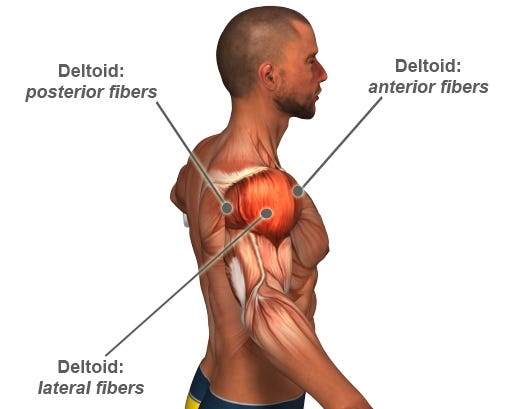
Anterior (Front) Deltoid. Raises the arm forward. Flexion. This is trained by every pressing movement you do; bench press, overhead press, push-ups. The front delt is the MOST overtrained muscle in most lifters’ bodies. It gets hit on chest day, shoulder day, and every time you press anything. Most guys do not need additional front delt isolation work.
Lateral (Side) Deltoid. Raises the arm out to the side. Abduction. This is the muscle that creates the wide, capped shoulder look. It is the hardest to develop and the most important for aesthetics. Lateral raises in all their variations are the primary tool. This is where most of your direct shoulder work should be focused.
Posterior (Rear) Deltoid. Pulls the arm backward. Horizontal abduction and external rotation. This is the most neglected head in almost every lifter. Weak rear delts cause shoulder impingement, rounded posture, and an incomplete look from the side. John was relentless about rear delt training.
The critical imbalance John saw constantly: front delts are overstimulated from all the pressing, rear delts are weak, and anterior shoulder pain is common. You have to fix this imbalance.
The Rotator Cuff
Four small muscles that stabilize the shoulder joint. They are not glamorous. They will never be visible. But if they are weak or dysfunctional, every pressing and raising movement you do is compromised. Rotator cuff health is the foundation of shoulder longevity.
John never skipped rotator cuff activation work. Neither should you.
Part 2: Progressive Resistance for Shoulders
Everything I explained about progressive resistance in the arm training article applies even MORE to shoulders.
Any kind of deltoid raise is an isolation exercise. You do not have infinite loading capacity. No one is doing strict lateral raises with 100lb DBs. The stability and weight requirements put a hard cap on how much weight you can use long term. The guys trying to swing 50lb dumbbells on lateral raises are using momentum, traps, and ego to move the weight. Do you want bigger shoulders, or shoulders that breakdown over time? Choose one.
John understood this better than anyone. His lateral raise technique was meticulous. Slow eccentrics. Controlled raises. A deliberate pause at the top. No swinging. No heaving. No ego.
Much like the stories of Arnold never using much more than 35lb dumbbells for arms, the same applies to deltoids.
Learn how to use 15-25lb dumbbells for lateral raises and you get more growth stimulus than guys trying to use twice the weight. This is progressive resistance in action: increasing the RESISTANCE on the target muscle.
For shoulders specifically, this means: slow your reps down. Eliminate momentum completely. Position your body to isolate the target delt head. Squeeze hard at the peak. Control the negative. Use angles and body position to create maximum tension with minimum weight.
The internal shoulder joint is small and vulnerable. Going heavy and sloppy is a setup for impingement, rotator cuff tears, and labrum damage. Go light and precise. Milk every rep for everything its worth. Then earn the right to add weight.
Part 3: Shoulder Training—Principles and Exercises
The Optimal Shoulder Workout Sequence
This sequencing comes directly from John Meadows.
First: Activate the rear delts and rotator cuff. Before touching any serious weight, you must prepare the shoulder joint. Band pull-aparts, face pulls with external rotation, light rear delt flyes with controlled tempos. This is not a warm-up you rush through. This is injury prevention AND it addresses the most common weakness — rear delt underdevelopment.
Most peoples shoulders are a mess before they even start training. The front delts are overactive, the rear delts are dormant, and the rotator cuff is compromised. Five minutes of activation work can save you months of shoulder problems.
Start every shoulder workout with 3-4 sets of band pull-aparts and face pulls. 15-20 reps. Controlled. Deliberate. This sets the foundation for everything that follows.
Second: A compound pressing movement. Now that the rear delts are activated, the rotator cuff is warm, and the joint is lubricated, you earn the right to press. Seated dumbbell shoulder press was Johns personal favorite. He preferred dumbbells over barbells for the natural movement pattern and reduced shoulder stress. Machine shoulder press variations are also excellent.
Johns pressing technique emphasized controlled eccentrics, full range of motion, and “owning the weight” rather than simply moving it from point A to point B. This is not a strength competition. This is about working the muscle.
3-5 sets of 6-12 reps, adding weight each set. Perfect form. Every rep.
Third: Lateral raise variations for side delt development. This is where the width shoulder building happens. The pressing warmed the joint and hit the front and side delts. Now you isolate the side delt with targeted lateral work.
This is where Johns innovative exercise selection truly shined. He developed and popularized variations that eliminated cheating and maximized tension on the lateral head. Cable lateral raises, incline lateral raises, machine laterals, all designed to remove momentum and force the side delt to do the work.
3-5 sets of 10-15 reps. Slow and controlled. Peak contraction held for a beat.
Fourth: Rear delt isolation and loaded stretching. You started the workout with rear delt activation. You finish with rear delt destruction. Machine Rear delts, reverse flyes, Y-raises, rear delt cable flyes. Then loaded stretching to finish, behind-the-back cable stretches, cross-body stretches with isometric holds. 30-60 seconds under tension.
The Top 5 Shoulder Exercises
This is not a definitive list of every possible exercise. These are favorite and effective movements, feel free to experiment and find your personal favorites.
1. Incline Bench press. Johns number one choice. If he could only do one shoulder exercise for the rest of his life, this would be it. Set up on the angled bench, lower the bar to about 3-4 inches above the chest, smooth reps. John favored pyramid sets on this, and working up to a heavy set in the 6-8 rep range. This could also be done on smith machine
2. Cable Lateral Raises. Cables provide constant tension throughout the entire range of motion, eliminating the dead spot that dumbbells have at the bottom. Stand about one foot from the cable stack, use an individual handle set at the lowest position, and raise to just above parallel. These were a staple in Johns programming and for good reason — the pump is unreal and the tension never lets up.
3. Face Pulls with External Rotation. The single best exercise for rear delts AND rotator cuff health simultaneously. Use a rope attachment on a cable set at face height. Pull toward your face, then rotate your hands outward so your arms finish in an externally rotated position. This trains the rear delt through its primary function while strengthening the external rotators. John used these in nearly every shoulder workout.
4. Incline Lateral Raise (The Meadows Lateral Raise). Set an incline bench to about 60 degrees. This eliminates momentum and helps to isolate the deltoids for constant tension. You cannot cheat these. Even 10-15lb dumbbells become brutal. John developed this variation specifically to address the problem of guys swinging weight on standard lateral raises. 3-4 sets of 12-15 reps.
5. DB rear delt raises. One of Johns most famous workouts was doing sets of these for 20-30 reps for 2-4 sets, and THEN doing pressing work. Not something you need to do every workout, but the practice of high rep rear delts works fantastic. The rear delt machine and cables are another option. 2-3 sets in the 15-30 rep range.
Part 4: Putting It All Together in a Workout
You have read a lot of principles. Here is how they actually combine into a single shoulder session.
A Meadows-style shoulder session follows a specific sequence.
You always start with activation. Band pull-aparts, face pulls, rotator cuff work. Higher reps, controlled tempos. The first thing you do sets up everything else. These are working sets, but you are also warming the joint, activating dormant muscles, and establishing the mind-muscle connection with the rear delts.
Then you press. Now that the shoulder is prepared and the stabilizers are firing, you earn the right to load up. Seated dumbbell press or machine press. This is your strength work. Perfect form, controlled eccentrics, moderate reps. You are building the mechanical tension that drives growth in the front and side delts simultaneously.
Then you isolate the side delts. Higher reps, constant tension, peak contractions held for a beat. Cable laterals, incline laterals, machine laterals. This is where metabolic stress does its work. The side delts respond best to volume and tension, not heavy loads.
Then you finish with rear delts and a stretch under load. Rear delt flyes, Kelso shrugs, Y-raises. Then hold a loaded stretch — cables behind the back, cross-body with isometric holds. This is 5 minutes of work that most people skip entirely. It provides a final growth stimulus and accelerates recovery between sessions.
Throughout the entire workout: forceful contractions on every rep. Three-second negatives on at least one exercise. Controlled tempos everywhere. No swinging, no momentum, no ego.
Part 5: How Much Volume Do Your Shoulders Actually Need?
Shoulders are trained more than you think. Every bench press, every incline press, every dip, every push-up hits the front delts. Rows and pull-ups hit the rear delts. Your shoulders are getting indirect volume from almost every upper body movement.
The mistake most guys make is piling direct shoulder volume on top of already high indirect volume. They press heavy for chest, then press heavy again for shoulders, then wonder why their shoulders ache constantly.
With Meadows-style intensity techniques — forceful contractions, controlled eccentrics, loaded stretches, peak contraction holds — you do not need a high number of sets.
The techniques do the work. Intensity takes precedence before volume.
But volume still matters. It just has to cycle.
Weeks 1-3: Medium Volume. 8-10 total direct sets for shoulders per week. Three exercises. Focus on execution, mind-muscle connection, and establishing the intensity techniques. The pressing sets count. The lateral work counts. The rear delt work counts. Dont add more — master what you have.
Weeks 4-9: High Volume. 12-18 total sets per week. Four to five exercises. Add frequency — hit shoulders twice per week. Increase the lateral raise variations. Add more rear delt volume. Introduce drop sets and rest-pause to your isolation work. Six weeks of grinding.
Weeks 10-12: Low Volume, Maximum Intensity. Drop to 6-8 total sets. Two or three exercises. But every set goes to failure or beyond. This is the peak. You are squeezing the last drop of growth out of the stimulus you built over the previous nine weeks.
Weeks 13-14: Deload. 1-2 weeks of light training. Not optional. The shoulder joint accumulates fatigue differently than muscles do. Tendons and ligaments need recovery time. The growth you see during the deload is often the most satisfying of the entire cycle.
One more thing. Account for your pressing volume on other days. If you are bench pressing heavy twice a week, your front delts are already getting hammered. You do not need 6 sets of overhead pressing on top of that. Be intelligent about total pressing volume across your entire program.
Part 6: Advanced Techniques for Stubborn Shoulders
When shoulders need extra attention beyond standard training, these advanced techniques provide the additional stimulus needed to force growth.
Iso-Tension Holds
The same technique Meadows applied to arms works beautifully for shoulders. At the top of each lateral raise, hold the peak contraction for 8-10 seconds. This teaches you to contract the side delt maximally and creates enormous metabolic stress. Apply this to any lateral raise or rear delt variation.
Pre-Exhaustion
Perform lateral raises BEFORE pressing. This ensures the side delts are the limiting factor during the press, rather than the triceps. Your pressing numbers will drop. Your side delt stimulation will skyrocket.
Giant Sets
Meadows loved giant sets for shoulders. Front raise into lateral raise into rear delt flye—one set for each head, no rest between. 3 rounds. This creates an incredible pump and hits all three heads in rapid succession. Use light weight. The metabolic stress is the stimulus.
Loaded Stretching
After your last working set, hold the stretched position under load for 30-60 seconds. For side delts: let a dumbbell hang at your side and lean away from a post, stretching the delt. For rear delts: hold a cable in a cross-body position under tension. Extreme mechanical tension in the lengthened position is one of the strongest stimuli for hypertrophy.
High-Frequency Stimulation
For truly stubborn shoulders, Meadows recommended training 2-3 times weekly. With this strategy, volume would be low in every workout, and you’d leave a rep or two in the tank on sets. This required actively managing training and making sure that you recovered between sessions. You would also want to vary the rep ranges in each workout, 6-10 in the first , 8-12 in the second, and 12-15+ in the third, then repeat.
Part 7: Troubleshooting—Solving Common Shoulder Problems
Shoulder Impingement
The number one shoulder complaint in the gym. The front delts are overdeveloped, the rear delts are weak, and the rotator cuff is compromised. The fix: prioritize rear delt development 2:1 over front delts. Use neutral grip variations whenever possible. Avoid overhead pressing until the imbalance is corrected. Emphasize scapular mobility and stability. Face pulls every single workout.
Stubborn Side Delts
Increase training frequency to every 48 hours. Use cable variations for constant tension. Implement the Meadows incline lateral raise to eliminate cheating. Add iso-tension holds to every set. Vary angles — slightly in front, directly to the side, slightly behind. Each angle hits different fibers.
Lagging Rear Delts
Train them first in the workout, not last. Increase frequency to every training session, regardless of what body part is being trained. 2-3 sets of face pulls or band pull-aparts before every workout takes less than 3 minutes and will transform your rear delts within 8 weeks.
Chronic Shoulder Pain
Start with isometric holds and very light weights. Focus on pain-free range of motion only. Gradually progress over 6-8 weeks. Never train through sharp pain. Dull ache after activation is acceptable. Sharp pain during movement is a stop sign. Switch the exercise, dont push through it. John was adamant about this.
Shoulder Imbalances
Address the weaker head with a 2:1 volume ratio. Use the mirror honestly — most guys have overdeveloped front delts and underdeveloped everything else. If your shoulders look round from the front but flat from the side, you need more lateral work. If they disappear when you turn sideways, you need rear delt work. Monitor progress with weekly photos from multiple angles.
Part 8: Special Considerations
For Tall Lifters (6ft+)
Long arms mean longer levers on pressing movements. You will not press as heavy as shorter lifters. Accept this. Focus on dumbbells over barbells for pressing — the natural arc is easier on long-levered shoulder joints. Lateral raises with cables are your best friend — constant tension compensates for the mechanical disadvantage. Higher reps, always. 10-20 rep range for isolation work.
Balancing Shoulders with Chest Training
If you train chest and shoulders on separate days, be mindful of total pressing volume. Heavy bench pressing on Monday and heavy overhead pressing on Wednesday means your front delts never recover. Either combine them on the same day (chest first, shoulders after) or ensure at least 72 hours between heavy pressing sessions.
Johns preferred approach was training shoulders after chest on push days, taking advantage of the pre-fatigue. The front delts are already warm and pumped from pressing, so you can focus your shoulder work on side and rear delts where it matters most.
Building the V-Taper
Wide shoulders are only half the equation. The V-taper — the visual ratio of shoulder width to waist — requires both building the shoulders AND keeping the waist tight. Lateral delt development creates the width. Keeping bodyfat in check reveals it. You can have the biggest shoulders in the world and they wont look wide if your waist is 40 inches.
Part 9: Cannonball Delts Workout
A complete shoulder session using the four-phase system.
A1. Band Pull-Aparts — 3 x 20 Controlled tempo, squeeze the shoulder blades at the back. Activate the rear delts. (Phase 1)
A2. Face Pulls with External Rotation — 3 x 15 Rope attachment, face height. Pull and rotate. Feel the rear delts and rotator cuff fire. (Phase 1)
B. Smith Machine High Incline Shoulder Press — 4 x 10, 8, 8, 6 Full range of motion. Control the descent. Own the weight. Add weight each set. (Phase 2)
C1. Cable Lateral Raises — 3 x 12-15 One arm at a time. Constant tension. Pause at the top for a one-count. No swinging. (Phase 3)
C2. Incline Lateral Raise (Meadows Lateral) —3 x 12-15 on incline bench. Light weight with DBs. Feel every fiber. (Phase 3)
D. Rear Delt Cable Flyes — 3 x 15-20 Cables set at shoulder height. Cross the arms in front, pull back to full contraction. Squeeze. (Phase 4)
Finish: Cross Body stretching for rear delts—30-60 seconds each. (
Train hard. Build the V-taper.
Sick
Apprecaite this guide, along with the arm workout from the other day. Great resources.
You mentioned notes for 6"+ lifters of which I belong to. Are there any other resources or directions you can point me to? I've finally reached a stage where I worry the added weight and intensity might become a limiting factor based on my geometry, and would like to avoid any injuries that come with it.