

Before we begin…
Download the A-Z BroScience Guide to peptides
Join the BroScience Telegram
Use code AJAC10 at Eliteresearchusa.com
On to the article
Strong legs are for everyone. Whether you are a casual lifter or hardcore, its in your best interest to train legs HARD.
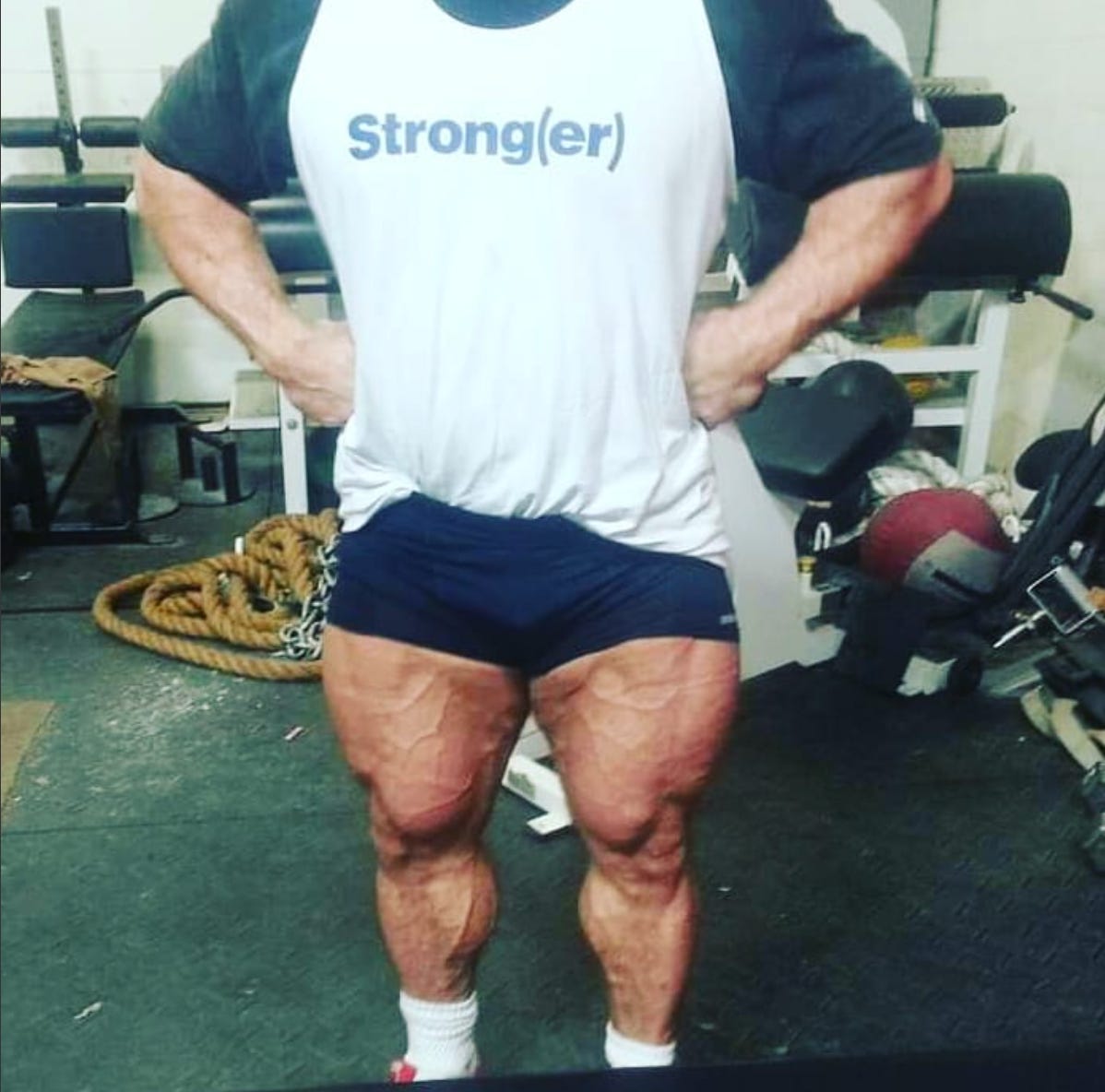
I would say more than any other muscle group, your lower body determines quality of life.
When I regularly trained clients, there was an enormous difference in athleticism and quality of life between weak-legged people, versus strong legs.
It was not just an easier time doing squats or deadlifts or lunges, but an obvious difference in coordination, stability, stamina, energy levels.
People with strong legs are energetic, mobile people.
Weak legs, youre not inclined to move. AT ALL. Any kind of movement, evens standing bicep curls, they are more challenging.
And the older you are and weaker you become, inertia takes over. A cane or walker or wheelchair becomes your destiny.
This is all to say; train your legs like an intelligent bodybuilder (and athlete)
I say bodybuilder first, because everything starts with muscle. Telling someone to sprint, shuffle, hop, skip, and jump is a TERRIBLE idea if bodyweight squats and lunges are hard.
Muscle and basic strength comes first. Thats brings us to Mountaindog leg training via John Meadows.
John loved to train with intensity and intelligence, and his training approach for leg exemplified this. His philosophy was of course very different from the typical “just squat heavy!!”.
John recognized that the legs were a diverse set of muscle groups that were not going to be adequately stimulated by a minimalist approach. He incorporated all manner of squats, leg presses, lunges, single leg exercises, deadlifts, adductor work, leg curls and extensions, and hip thrusts. Not necessarily all in the same workout, but he liked a diversity of movements being done, and specifically targeted what needed to be brought up. And brought his usual focus on technique, targeted tension, intensity, and periodized training.
Ironically this was more a athletically oriented training style than most people would give credit for. Having equally strong quads, glutes, hamstrings, and single leg strength is a great strength base for doing anything locomotive.
John also called leg training “the crucible of character development.” By his estimation, legs were the bodypart that responded the most to sheer volume and intense effort. To achieve seriously impressive leg development is a long and painful process. There is no other muscle group thats is more exhausting and requires mental and physical stamina.
Lower body is also a muscle group that many people slack off on as they age. Or dial back intensity due to injuries and joint pain.
With the mountaindog system, you can keep intensity up, be pain free, and avoid the decline of losing lower body muscle. You also can achieve growth you may not have thought possible.
Part 1-Leg Anatomy
As always, its good to understand what muscles we are talking about here before getting into training.
Quadriceps
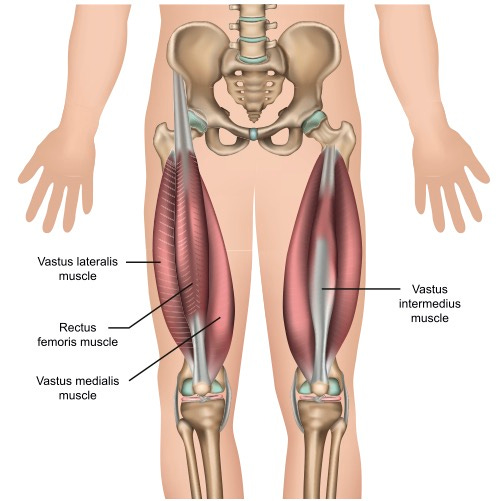
The quadriceps is four distinct muscles with different attachment points and different functions. While all of them work together, you can change the emphasis of tension with your exercise selection.
Rectus Femoris: The only quad muscle that crosses both the hip joint and the knee joint. This matters because it means the rectus femoris is most active when the hip is extended, which is why exercises like sissy squats and leg extensions with the torso upright produce such intense rectus femoris activation. Most compound movements underload this muscle.
Vastus Lateralis: The outer quad. This is the muscle responsible for the dramatic sweep that makes legs look wide from the front. It responds well to heavy compound work and wider-stance movements.
Vastus Medialis (VMO): The inner quad, creating the teardrop development above the knee that separates serious leg development from average. The VMO is most active in the terminal range of knee extension, the last 20 degrees of lockout. This is why exercises that emphasize full lockout and short-range movements near extension build the teardrop.
Vastus Intermedius: The deep quad muscle sitting underneath the rectus femoris. It provides thickness and foundational power. You cannot see it directly, but you can see its effects in overall quad mass.
Hamstrings
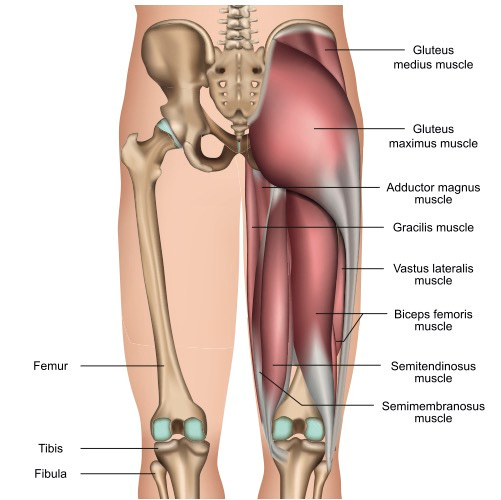
Biceps Femoris (Long and Short Heads): The outer hamstring. The long head crosses the hip joint, making it responsive to hip extension exercises like Romanian deadlifts. The short head only crosses the knee, requiring leg curl movements for complete development.
Semitendinosus: Runs along the inner portion of the posterior thigh. Performs hip extension and knee flexion with internal rotation of the tibia. Responds to Romanian deadlift variations and lying leg curls.
Semimembranosus: The deepest hamstring muscle, providing mass and strength for hip extension and knee flexion. Often underdeveloped because it requires specific attention through both hip hinge and knee flexion work.
Glutes
Gluteus Maximus: The single most powerful muscle in the human body. Responsible for hip extension, external rotation, and the posterior chain power that drives every athletic movement.
Gluteus Medius: Sits on the outer hip. Essential for hip stability, single-leg balance, and lateral strength. Can be targeted directly and also works during any compound exercise.
Gluteus Minimus: The deep stabilizer beneath the medius. Works with the medius to control hip position during movement.
Calves
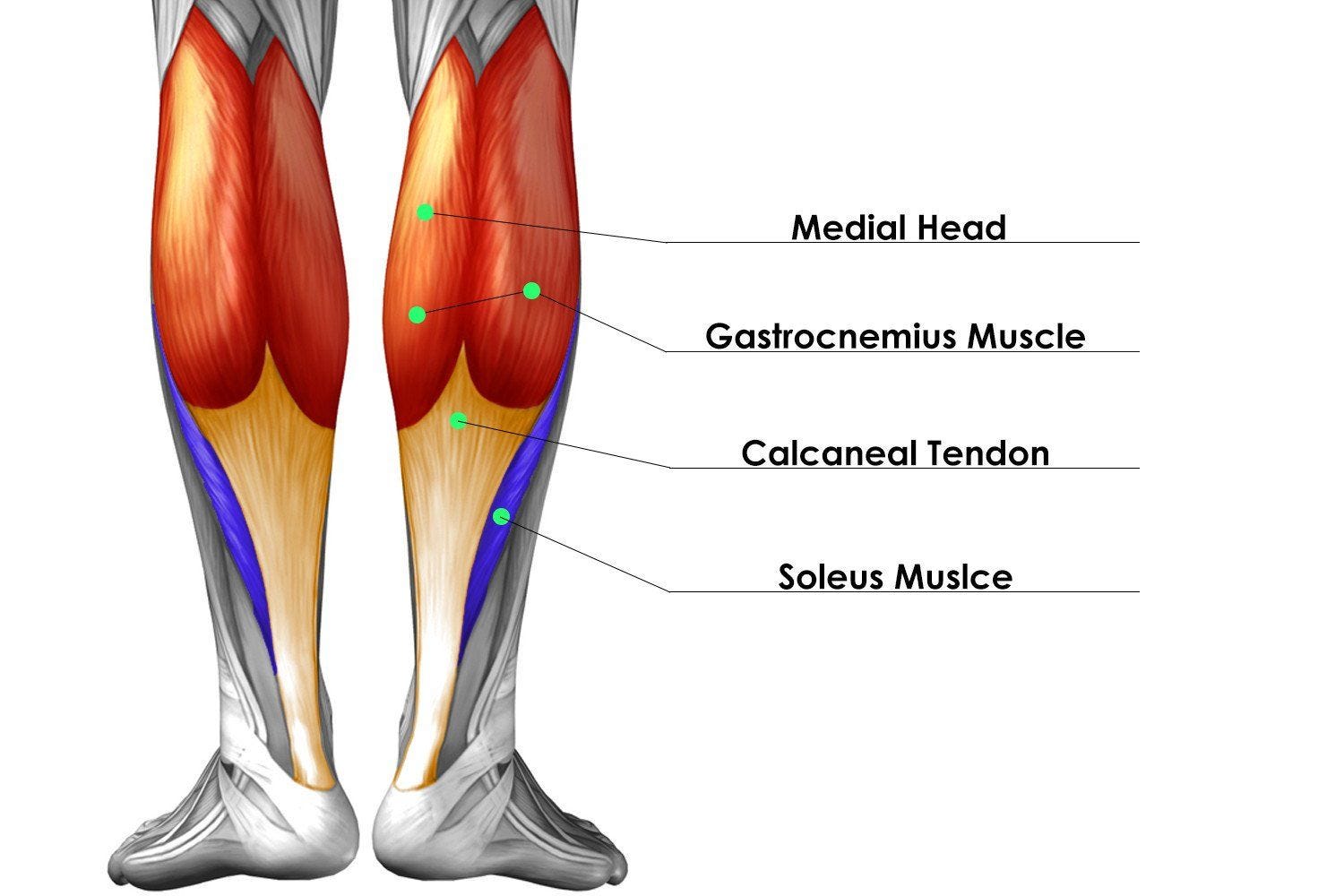
The calves are arguably the most genetically stubborn muscle group in the entire body. Some people have huge calves and literally never train them. Someone else is trashing them through 8 sets to failure just not have toothpick lower legs.
The biggest mistake with calves is most people train them as an afterthought, and then say their genetics suck. Maybe your genetics do suck, but calves respond to intelligent, systematic training just like everything else. And a lot of patience.
Gastrocnemius-the outer, visible calf muscle that creates the classic diamond shape when fully developed. It has two distinct heads. The gastrocnemius crosses both the knee joint and the ankle joint, which means it is most active during plantarflexion (pointing the toes) when the knee is straight. This dual-joint function is the reason standing calf raises are a key exercise for gastrocnemius development.
Soleus-sits underneath the gastrocnemius and is not visible from the surface, but it is the muscle most responsible for overall calf thickness and mass. Because the soleus only crosses the ankle joint and not the knee, it becomes the primary working muscle during any calf exercise performed with bent knees. This is why seated calf raises are essential and not interchangeable with standing variations. The soleus also contains a higher proportion of slow-twitch muscle fibers than the gastrocnemius, which means it responds better to higher repetition ranges and longer time-under-tension protocols. Neglecting the soleus while chasing gastrocnemius development is one of the most common reasons lifters struggle with overall calf size. Think of the soleus as the triceps of the calf muscle.
Part 3-Workout Principles and Exercise Sequencing
With training legs, the order of exercises mattered as much as the intensity applied to the movements. Similar to Chest training, John was specific about sequencing movements to both avoid injuries and discovered through decades of practical experimentation that specific sequencing patterns consistently produced superior results in both size development and injury prevention.
First-Start with hamstrings. This is probably Johns most famous recommendation that know one knows came from him. His reasoning was simple
The hamstrings crosses the knee joint. Most people have weak hamstrings. Training hamstrings hard both is stimulating for muscle growth, and helps lubricate the knee joint for deep knee bending. Squats and leg presses performed with pre-activated, pumped hamstrings simply feel more stable and produce better muscle engagement patterns.
Additionally, save your stretching-type hamstring movements, such as stiff-legged deadlifts and Romanian deadlifts, for after both hamstrings and quads are fully pumped. The increased blood flow and tissue temperature make the stretched position more productive and less risky for the lower back.
For hamstrings, you have the options of either lying leg curls, or seated leg curls. John never did much standing leg, he preferred the bilateral version of the exercise. Alternate between the two. You can do dropsets, isoholds, partials, and go hard on hamstrings over multiple sets.
John typically trained hamstrings and quads within the same session rather than on separate days. He thought the combined stimulus produces greater overall lower body growth than splitting them apart, and the alternating tension between antagonist muscle groups enhances performance on both.
Even if splitting your legs into workouts, quads one day, posterior chain on another, John always wanted some leg curls before any knee bending. Assess whether this works for you
Second-Perform a compound squat movement with 90 degrees of knee bend. Johns recommendation from years ago was to always do a squat or leg press first before hack squats. And to always do two quad exercise before lunges.
What was the reasoning behind this?
It had to do with stress on the knee joint. When you have a fully pumped and engaged muscle, there is less joint stress. For an exercise like a lunge (a single leg movement) or a hack squat, thats a lot of stress on the knee joint. So do NOT do those exercises first.
Instead, do some kind of squat or leg press with about 90 degree range of motion. This could be a back squat, smith machine squat, and any leg press of choice. This allows you to push weight, safely, and you dont make the mistake of doing deep knee bend before your knees are prepared. This exercise is also stimulating to both quadriceps, and to the glutes as well.
Third-Perform a compound squat movement with deep knee bend. After doing your first compound movement for quads (and glutes), now you are ready for a hack squat, smith machine lunge, or split squat. John loved them all, especially bulgarian split squats.
This exercise you can apply any intensity techniques you like; dropsets, partials, slow eccentrics, or any combo thereof.
Important to note for this exercise; John liked stable movements. Walking lunges he didnt consider a long term mass builder due to the stability demands and the limitations of overloading the movement safely without form breakdown. You could do them, but they were an exercise you’d do at the very end of a workout. They were also not something to prioritize over foundational pressing and squatting when overall quad mass is the primary goal.
4th, finish with your loaded hinges for hamstrings and glutes. John typically saved RDLs and Stiff legs for the very end of a training session, but he would sometimes put them second after leg curls if the posterior chain was a lagging muscle group. This is up to you. For working sets, John also rarely went below 8 reps on hinges, and typically stuck to the 8-12 range, and would usually work up doing pyramids. Hinges are not exercises that readily lend themselves to intensity techniques, simply doing quality reps and pushing yourself on sets if enough.
Part 4-Calf Training
Calves deserve their own section. John would train Calves on leg day, but he also believed in training them up to 5 times a week if they were lagging, and encouraged higher frequency versus 1-2 workouts weekly. If your calves are terrible, they could also be trained first in the workout. John never had an exact protocol for calves, but he did have principles
High Frequency and Volume-Once a week is not enough for stubborn calves.
Meadows prescribed calf training 3-6 times per week during specialization phases. Sessions were short, 10-15 minutes, alternating between gastrocnemius emphasis (straight-leg movements) and soleus emphasis (bent-knee movements). Sets could be 2-3 per exercise. These mini workouts were not high volume, but over the course of the week, it aded up significantly.
f calves are a genuine weak point, they also need to be trained first in the session. not tacked on at the end when you’re mentally checked out and physically drained.
Rotate rep ranges-heavy work in the 6-10 range for progressive overload, moderate sets of 12-15 for hypertrophy, and occasional high-rep sets of 20-30+ (or even 100-rep challenges) to target the slow-twitch dominant soleus and develop pain tolerance.
each workout, use a different range, dont stick to only one.
Full stretch with PAUSE-Three things destroy calf rep quality: cutting the range of motion short at the bottom, bouncing out of the stretch using the Achilles tendon as a spring, and going too heavy to maintain control.
The fix is simple and non-negotiable. Drop your heels to a full stretch at the bottom of every rep. Pause there for one full second. Drive up with muscular force — not elastic rebound. Keep your legs straight on standing variations to load the gastrocnemius instead of shifting to the soleus.
This means using less weight than your ego wants. That’s the point. A controlled 3-second eccentric, 1-second pause, explosive concentric rep with 60% of your max is worth more than a bouncing half-rep at 100%.
The tibialis anterior-John was the only bodybuilder I met who seriously trained this muscle. One of his favorite routines was supersetting “tib raises” with calf raises. Is this the secret to growth? I dont know, but its worth trying.
Part 5: Programming Legs Within the Training Week, Considerations
There are LOTS of ways to program lower body, the following are practical tips for the training schedule.
For Push/Pull/Legs Splits
Legs receive their own full training day. The session lasts seventy-five to ninety minutes including activation work. John preferred legs trained on the day after a full rest day to ensure maximum energy and glycogen stores.
For Upper/Lower Splits
Two leg sessions per week with different emphasis:
Day 1 — Quad Emphasis: Safety bar squats or front squats as the primary compound. Leg press with low foot position. Leg extensions with VMO emphasis. Quad-dominant metabolic finisher.
Day 2 — Posterior Chain Emphasis: Romanian deadlifts as the primary compound. Hip thrusts as the secondary compound. Lying leg curls with the pre-stretch method. Reverse lunges from a deficit. Glute and hamstring-focused metabolic finisher.
For Body Part Splits
John sometimes separated quads and hamstrings into dedicated training days for advanced trainees during specialization phases. Quad day included all squat variations, leg press work, leg extensions, and quad-focused finishers. Hamstring day included Romanian deadlifts, good mornings, lying and seated leg curls, Nordics, and glute-dominant finishers.
Recovery Considerations
Allow a minimum of seventy-two hours between heavy leg sessions. Avoid heavy deadlift work within forty-eight hours of hard leg training. The overlap in posterior chain demand between these sessions is too great for adequate recovery. Train legs on your highest-energy day of the week, typically early in the week after better weekend sleep and nutrition. Eat a solid meal ninety to one hundred twenty minutes before training. Hydrate with at least a liter of water in the hour before training and sip throughout the session.
Part 6: The 12-Week Periodization Cycle
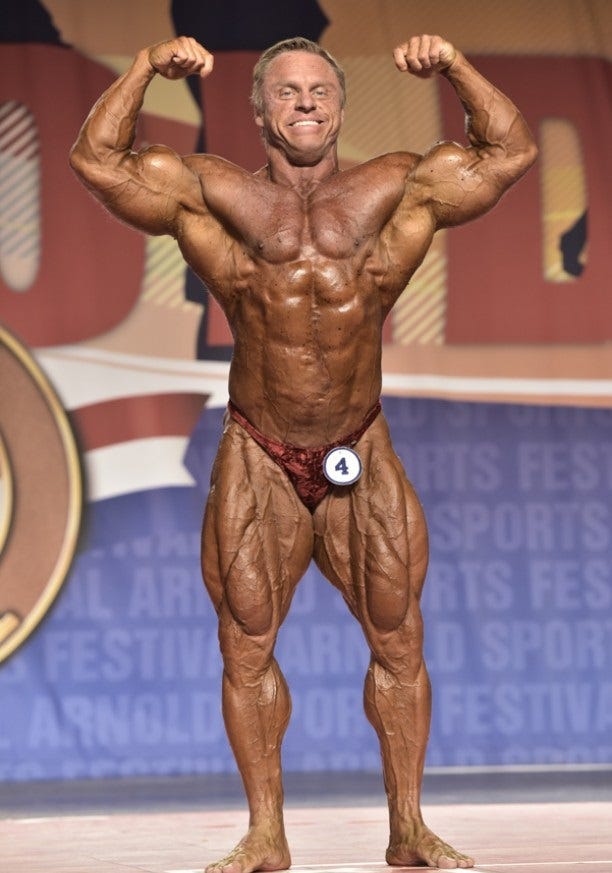
Individual workouts are the building blocks. But it is the long-term periodization of volume and intensity across weeks that determines whether those workouts produce continuous adaptation or diminishing returns. John structured his leg training into a systematic twelve-week cycle with three distinct phases, followed by a mandatory deload period.
The philosophy underpinning this cycle was what John called “getting the most out of the least.” Start with conservative volume and allow the high-intensity execution techniques themselves to provide the initial shock. Then systematically increase total work capacity over time. Finally, compress the volume while maximizing the intensity of every individual set. This wave-loading approach prevents premature adaptation and generates favorable hormonal responses as training stress accumulates.
Planning a 12 week training Cycle
John was fond of planning training out in cycles, and liked to use the “Moderate-High-Low” approach
Weeks 1-3-About 10-12 sets per workout
Week 4-9- increase to 12-20 sets per workout
Weeks 10-12- decrease to 8-10 sets per workout
Sample Phase 1 Workout (12 Working Sets):
A. Lying Leg Curl — 4 working sets Two warmup sets of twenty reps. Then one set of fifteen, one set of twelve, and one set of eight, adding weight each set. Rest approximately ninety seconds between sets. Final set is a cascading drop: return to the weight you used for twelve reps and perform ten, reduce the load and perform ten more, reduce again and perform ten more, then increase the load by one increment and perform twenty-five partials from the lengthened position.
B. Barbell Stiff-Legged Deadlift — 2 working sets Two warmup sets to establish the pattern. Then two working sets of ten repetitions. Bend the knees at the bottom. Use smaller-diameter plates to achieve a greater stretch. Contract the glutes and hamstrings deliberately on every rep.
C. Leg Press — 3 working sets Feet slightly wider than shoulders, positioned on the lower half of the platform. Begin with light weight and add plates progressively through warmup sets. You should still feel hamstring and adductor engagement during the eccentrics of the early sets. Perform three working sets of ten with three-second negatives and explosive concentrics. Follow immediately with a sixty-second quad fascial stretch per leg.
D. Hack Squat — 3 working sets Three sets of ten with full range of motion and no lockout. On the final set, use the same weight but add the rest-pause explosion technique: full depth, complete pause, then drive hard. Perform ten reps this way, then cut the weight in half and finish with fifteen additional continuous-tension reps. Follow with fascial quad stretching, sixty seconds per leg, repeated twice.
Phase 2: Volume Accumulation (Weeks 4-9)
Total volume per session: sixteen to twenty working sets.
This is a hard six-week grind. The body has begun adapting to the intensity techniques introduced in Phase 1, so to continue driving adaptation, total training volume increases progressively each week. The number of high-intensity sets also increases. This phase generates the greatest cumulative training stress of the entire cycle and produces the most visible changes in leg development.
Volume does not increase recklessly. It climbs by one to two sets per week, distributed across the session. The additional sets prioritize movements and techniques that have proven most effective during Phase 1.
Sample Phase 2 Workout (17 Working Sets):
A. Seated Leg Curl — 4 working sets Two warmup sets of twenty. Then one set of fourteen, one set of twelve, one set of ten, adding weight each set. Rest sixty seconds between sets. Final set: reduce to a weight two increments below your starting point and perform thirty-five continuous reps. The first ten will feel manageable. Then the burning begins. Reach thirty-five even if the final reps are partials.
B. Leg Press — 3 working sets Two warmup sets building to a load you could normally handle for ten to twelve reps maximum. Stay with that weight for all three working sets of sixteen reps. Standard foot positioning: shoulder width, toes forward, medium platform height. Continuous-tension style with no lockout. Work the lower portion of the range hardest. Use your hands to assist your knees if necessary during the final reps. Rest approximately two minutes between sets.
C. Hack Squat or Machine Squat — 3 working sets One warmup set. Three working sets of eight using the rest-pause explosion technique: full depth, complete pause, explosive drive, no lockout. The load should be moderate enough to allow perfect depth and a genuine dead stop on every repetition. Your legs should be extraordinarily pumped after three sets. Follow with sixty-second fascial quad stretches.
D. Smith Machine Squat — 3 working sets Two sets of eight with full depth. Third set: eight reps using the one-and-a-half technique. Descend to the bottom, rise halfway, descend to the bottom again, then drive to the top. That is one repetition. Follow with fascial quad stretching.
E. Dumbbell Stiff-Legged Deadlift — 4 working sets Four sets of twelve reps. Do not fully straighten at the top. Maintain a slight knee bend at the bottom. Focus on deepening the stretch progressively across the four sets. Keep the dumbbells against the body throughout.
Phase 3: Intensity Peak (Weeks 10-12)
Total volume per session: eight to ten working sets.
Overall volume drops substantially, but the intensity of every individual set reaches the highest level of the entire cycle. Every working set is preceded by thorough warmup work. Every working set is performed with maximum application of the intensity techniques. This is where the accumulated training capacity built during Phase 2 is expressed through the most demanding sets of the trainee’s life.
The reduced volume allows recovery between sessions while the extreme intensity continues to drive adaptation. This phase produces the most dramatic improvements in muscular density and detail.
Use your imagination in programming this phase. Combine every intensity technique available: three-second eccentrics with cascading drop sets. Continuous-tension sets with partials at the end. Rest-pause explosions followed by high-rep burnouts. Every combination of the five techniques is available, and the eight to ten sets you perform should be the hardest work you have ever done in a gym.
Deload Phase (2 Weeks)
After twelve weeks of escalating intensity, a mandatory period of lighter training allows recovery from the cumulative neural and muscular fatigue that accompanies sustained high-intensity work. Two weeks of reduced loading and reduced volume is the standard recommendation.
Not everyone requires the deload at the same point. Some trainees benefit from inserting a deload around week six. Others have sustained thirty or more weeks of intense training before requiring a recovery period. Monitor your performance, your motivation, and your joint health. When progress stalls and motivation drops simultaneously, the deload is overdue.
Sometimes the wisest training decision is taking one step backward to enable two steps forward.
Part 7: Training Age and Progressive Complexity
The periodization demands of a first-year trainee are radically different from those of someone with a decade of serious training experience. John scaled his periodization complexity to match the trainee’s readiness.
Beginners (0-2 years) benefit most from consistency and simplicity. A single twelve-week cycle repeated with gradually increasing loads and modest exercise rotation provides all the periodization complexity they need. The body is so responsive to novel training stimuli at this stage that elaborate periodization schemes add confusion without adding results. The priority is building movement competency, establishing training habits, and developing the pain tolerance to eventually handle Mountain Dog-level intensity.
Intermediate trainees (2-5 years) begin benefiting from the three-week exercise rotation, the full three-phase volume wave within each cycle, and targeted specialization blocks for lagging muscle groups. This is the stage where most trainees stagnate because they continue applying beginner-level programming to a body that now requires more sophisticated stimulus management. Introducing the complete twelve-week cycle structure with deliberate exercise rotation is often the single change that breaks an intermediate plateau.
Advanced trainees (5+ years) require the full macro-level architecture: multi-cycle annual planning, specialization block sequencing, strategic exercise rotation, and careful management of the relationship between training stress and recovery capacity. The room for error shrinks as training age increases. An advanced trainee can no longer rely on general effort to drive adaptation. Every variable must be deliberately managed, and the consequences of poor periodization, whether overtraining or understimulation, become more severe.
John expressed this progression simply: there is no such thing as a universally perfect program. There is only a perfect program for a specific individual at a specific point in their development. The periodization framework exists to ensure that the program evolves as the individual does.
Part 8-Activation and Movement Preparation
John didnt necessarily do “prehab” activation drills before every workout during his competitive career, but they are something he saw the merit of doing for general population, older lifters, and even novices who hadnt yet developed kinesthetic awareness.
The Meadows Leg Activation Sequence (for everyone):
20 clamshells each side — slow and controlled, feeling the glute medius engage
15 bodyweight glute bridges with 2-second holds at the top — squeezing hard enough to feel the glutes cramp
15 leg swings each direction — front-to-back and side-to-side, working through full range of motion
10 deep bodyweight squats — full depth, holding the bottom position for 2 seconds each rep
5 single-leg glute bridges each side — confirming both sides activate equally
Ankle Mobility Work: John understood that many squat problems originated at the ankle, not the hip. Restricted ankle dorsiflexion forces the torso forward, shifting load from quads to lower back. His fix was simple: spend 60 seconds per side in a half-kneeling ankle stretch before any squatting movement.
Hip Flexor Stretches: A 30-second couch stretch or half-kneeling hip flexor stretch per side. Not deep stretching, just enough to restore normal range before loading.
Part 9-Addressing Common Leg Training Problems
For Stubborn Quad Development:
The problem was almost always the same: too much emphasis on heavy squats with insufficient quad isolation. John’s fix was to flip the priority. Start every leg session with pre-exhaust, light leg extensions for activation, then heels-elevated squats or front squats for primary loading. Finish with sissy squats or leg extensions with pauses. Most trainees who thought they had “bad quad genetics” had bad quad programming.
For Lagging Hamstrings:
John observed that most trainees treated hamstrings as an afterthought, a few sets of leg curls at the end of a quad session when they were already exhausted. His fix: dedicate one full training day per week exclusively to hamstrings and glutes. Romanian deadlifts as the primary compound. Lying leg curls as the primary isolation. Nordic progressions for eccentric strength. Train hamstrings fresh, not fatigued.
For Underactive Glutes:
The daily activation protocol was the starting point. Beyond that, John recommended removing bilateral squats temporarily and replacing them with Bulgarian split squats and hip thrusts as primary movements. The unilateral work forced the glutes to fire because the lower back could not compensate the way it did during bilateral movements.
For Knee Pain During Squats:
John never told anyone to “push through” knee pain. His approach was methodical: first, check ankle mobility, restricted ankles are the number one cause of knee compensation in the squat. Second, reduce range of motion temporarily to pain-free depth. Third, switch to leg press or hack squat, which provide external stabilization and reduce shear force. Fourth, increase VMO work through single leg extensions with light weight. Fifth, strengthen the glute medius to prevent knee valgus.
For Hip Shift During Squats:
A common problem where one hip rises faster than the other. John’s diagnostic: perform 3 sets of 10 Bulgarian split squats per side and note which side is weaker. The weaker side gets an extra set at the beginning of every leg session for 6 weeks. He also prescribed single-leg press work to identify loading differences between sides.
For Lower Back Taking Over:
When the lower back dominated during squats and Romanian deadlifts, the issue was almost always weak glutes and poor bracing. John’s fix: glute activation before every set. Brace the core with a full breath before unracking. Use a belt for working sets. If the lower back still dominated, switch to safety bar squats or leg press until glute strength caught up.
John’s practical recommendations for maximizing leg training performance:
Train legs on your highest-energy day of the week. For most people, this meant early in the training week after a weekend of better sleep and nutrition.
Eat a solid meal 90-120 minutes before training. Leg sessions on an empty stomach produced inferior output.
Music matters more for legs than any other body part. Whatever gets your intensity up — use it.
Hydration. John recommended a full liter of water in the hour before leg training and sipping throughout.
In Closing
John was a great mentor to me, and I want Johns work to live on. I hope you’ve learned strategies and tips from this series, and Id encourage you to watch his videos.
RIP Mountaindog.