

Happy Birthday America.
Patriotic music only this weekend.
Lets talk about Muscle
Americans love to build muscle, and America is the bastion on bodybuilding. We are going to BRO OUT with this article.
A Muscle has 4 Sides
This is a Vince Gironda bodybuilding concept, the original Iron Guru.
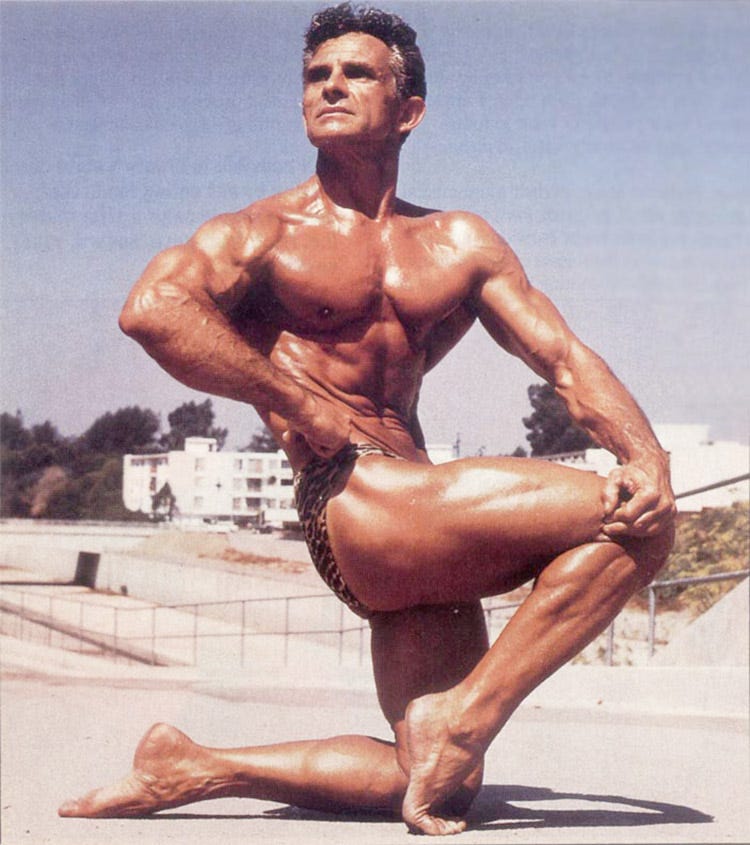
Like many of Vinces ideas, it preceded formal proof from exercise science. Modern research has demonstrated that the positioning of an muscle during an exercise affects its ability to contract, and it IS possible to emphasize and bias different sections of a muscle. Exercises are NOT all equal in how they recruit muscle tissue.
Instead of treating a muscle as a 2D flat, single entity, Gironda argued that every muscle group possesses distinct architectural “sides”.
Gironda typically categorized muscles into an upper, lower, inner, and outer aspects (or its various anatomical heads).
The 4-side model maps to the muscles origin and insertion point, as well as its medial and lateral sections.
While you cannot change the underlying structure of your muscle bellies and tendons, you absolutely can train your muscles with a complete set of exercises that hit all 4 sides and maximize your genetic potential.
The Workout Structure
A workout that followings this model typically breaks down to 4 exercises. These can be one at a time (straight sets), and done for 3-4 sets.
The exercises can also be done as a Giant Set, done one after another. In Girondas system, this would be a more advanced strategy. Milo Sarcev is an example of a modern bodybuilding coach that uses a Giant set strategy, although he goes crazy with it and will do 10 different exercises, each from a different angle and strength curve.
To be clear, I dont recommend this for natural lifters, but it does illustrate the concept.
Setting up the Workout
You select 4 exercises, each precisely targeting a different “side” or angle of the muscle.
For reps do 8-12 reps per set. You can pyramid up in weight if you want, or use the same weight for all sets.
For sets, you do 3-4 sets per exercise. That works out to 12-16 sets. Start with 3 sets per exercise.
Dont train to failure. Leave 1-2 reps in reserve on each set. If you want to go to failure, do so on the very last set of each exercise.
The Density Principle. Vince advocated very short rest periods, 30-60 seconds maximum between sets. He liked a higher volume approach to training, usually doing 10-15 sets per muscle group. You can choose to do this or not do this. Short rest periods do create a cardiovascular training effect
Workout Examples
Chest (Pectorals)
Chest is probably the best example of the concept. You have your upper pecs, the lower pecs. The pec minor. And if you grow enough muscle and get lean, you can see inner fiber detail.
Upper : Incline Barbell Bench Press (Grip wide, lower to the collarbone with elbows flared wide).
Outer, Lower Sweep: Wide-Grip V-Bar Dips (Chin tucked, torso leaned forward, feet flared out in front).
Overall Mass: Gironda Neck Press (Flat bench, wide grip, lowering the bar strictly to the bottom of the throat).
Inner Sternal Fibers: Low Cable Fly Crossover (Bring hands together and cross them over at hip/waist level, squeezing the inner sternal fibers).
Back (Lats & Mid-Back)
The Concept maps well onto the back, although its moreso because the back is multiple muscles, with multiple lines of movement.
Upper Width: Wide-Grip Lat Pulldown to the Chest (Leaning slightly back to hit the upper, outer lat sweep).
Lower Lats: V-Bar/Close-Grip Pulldown (Pulling down deeply to the lower ribcage to target the low insertion points).
Mid-Back Thickness: Seated Cable Row to the Belly Button (Chest out, pulling low and pulling the shoulder blades hard together).
Outer/Lower Tie-In: Straight-Arm Cable Pull-Downs (Keeping arms locked, sweep the bar down to the thighs using pure lat power).
Shoulders (Deltoids)
The delts is where the concept gets murky, but still useful. The deltoids are actually the largest muscle group in the upper body in terms of overall surface area, with seven subsections. They dont have “4 sides” but rather a large circular range of directions that can be thought of front, side, overhead, and posterior, with each direction working a different section of the muscle.
Lateral Head (Width): Seated Dumbbell Lateral Raises (Palms facing down, slightly pouring the pinkies up at the top).
Anterior Head (Front): Seated Alternate Dumbbell Front Raises (Lifting the dumbbell up and slightly inward toward the midline).
Posterior Head (Rear): Prone Incline Dumbbell Rear Delt Flyes (Lying chest-down on a 30-degree incline, flaring elbows out).
Overall Mass: Dumbbell Upright Row (Standing lateral raise where you swing the weights up from the hips, flipping the wrists smoothly at the top—a unique Gironda favorite for capping the side delt).
Thighs (Quadriceps & Hamstrings)
During Girondas time, the development of the hamstrings wasnt particularly emphasized and especially not the glutes. This is not to say that bodybuilders ignored the hamstrings and glutes entirely, as they did do leg curls, and occasionally stiff leg deadlifts, but there wasnt any emphasis on having shredded gluteals or hamstrings, and having oversized legs was considered undesirable. As good as the Golden Age bodybuilders looked, by modern standards their legs would be underdeveloped.
That said, they also look much more aesthetic than modern bodybuilders, and its not as if their legs were SMALL.
That said, Girondas leg workouts all emphasize quads, and he famously avoided the back squat, as he considered it a “butt lift” that was only useful for women (who wanted a big ass).
Times have changed. Regardless, his leg workouts are joint friendly and quite excellent for mobility+mass.
Lower/VMO: Gironda Hack Squat / Frog Squat (Heels together, toes flared wide at 45 degrees, keeping hips forward to force the load onto the lower tear-drop quad).
Outer Sweep and overall mass: Leg Press with Feet Low and Close (Puts the tension into the vastus lateralis on the outside of the thigh).
Rectus Femoris (Upper/Mid Quad): Leg Extensions (Lean back and pause at peak contraction to hit the upper hip-flexor tie-in).
Hamstrings: Lying Leg Curls (Keep hips pressed firmly flat into the bench, toes pointed to maximize hamstring loading).
Biceps
I have awful bicep genetics (short muscle bellies, long tendons, and orangutang arms), and while I personaly dont exactly follow the 4 side concept (wide grip curls give me tendintis), Ive found it effective for most people, especially those with more proportional structure. And if you’ve got long muscle bellies, its fantastic.
Outer Head and Peak: Incline Dumbbell Curls (Seated on a steep incline, palms facing strictly up/forward the entire time to stretch the long head).
Inner Head and Width: Wide-Grip Barbell Curls (Hands spaced well outside shoulder width to load the short head).
Brachialis and Lower Tie-In: Dumbbell Hammer Curls (Neutral grip, targeting the muscle that sits between the biceps and triceps).
Peak Contraction: Gironda Drag Curls (Keep the barbell scraping directly up the line of your torso, pulling elbows straight back to isolate the bicep belly without front delt assistance).
Triceps
Just doing pushdowns is not enough. Gironda emphasized doing an overhead movement as a staple in every tricep workout. Make sure to warmup thoroughly on the first exercise, and keep the weights moderate. Tendinitis once it starts can be hard to get rid of. Train for the mind muscle connection.
Long Head (Inner Mass): Overhead Dumbbell or Overhead Rope Extensions (Deep stretch at the bottom to target the back of the arm).
Lateral Head (Outer Horseshoe): V-Bar Cable Pushdowns (Flaring elbows slightly out to emphasize the outer sweep).
Medial Head (Lower Elbow Mass): Reverse-Grip (Supinated) Cable Pushdowns (Underhand grip, driving straight down to isolate the lower tricep fibers near the elbow).
Peak Contraction: Tricep Kickbacks (Emphasizing a hard, 1-second lock-out contraction at the very top).
This is a VERY Bro Bodybuilder way to train.
If you train only one muscle a workout, this 6 days a week of training each muscle once per week.
Gironda would often recommend antagonistic supersets. So for example, biceps and triceps together. Or chest and back. This reduces the training days from 6 down to 5 or 4. You can combine or keep separate per your own training preferences.
I would close with an acknowledgement that Gironda wrote all of this down in the 1960s-1979s. Regional hypertrophy research validating it started showing up in journals around 2010. The man was a true broscientist ahead of his time.
Enjoy the 4th.
Grill something.
Then Monday, go build some American muscle.