

Low back pain is the most common kind of orthopedic pain. Around 80% of adults will experience low back pain at some point in their life.
On any given day, about 1 in 4 adults (in the USA) report low back pain.
Ive written many times before that most low back pain can be solved with general strength training. The fundamental issue is not anything wrong with your back, but rather your back is WEAK, and needs to be muscularly strengthened.
Deadlifts for low back pain

But what about HERNIATED DISCS?
This must be much more serious, right?
Maybe not. Sort of. Lets Talk about it.
To start with, lets define what a Disc is.
We are talking about the rubber soft tissue that attach vertebrae to one another.
A disc contain a soft center (the nucleus) and a tougher shell that is rubbery. If you were to feel one, it would feel like a very stiff circle made of gel. Discs act both as shock absorption, and they allow the spine to bend. You can imagine if your back was solid bone, movement would be largely impossible.
A disc herniation is a case where the disc is protruding out from its normal position in the intervertebral space, and there may be a narrowing of the disc to one side. Most disc herniations are posterior (meaning they bulge outward towards the back)
However, there are 4 levels of a “Disc Herniation”, ranging from minor (and possibly asymptomatic) to traumatic.
When people talking about herniating a disc, its typically a bulge or prolapse. The term herniation refers more to a level 3 extrusion
Here is a clear visual breakdown of the four levels
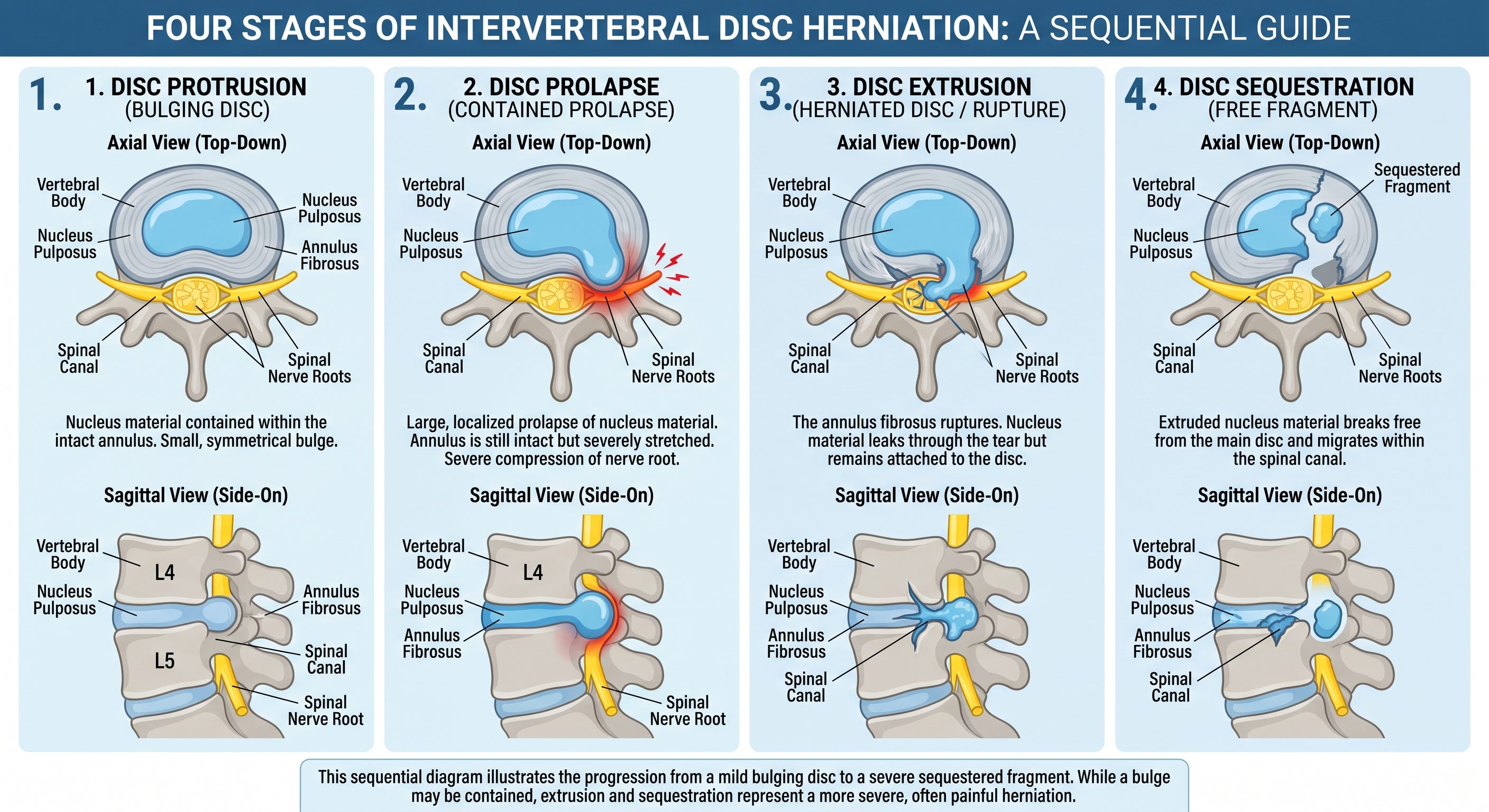
Level 1: Protrusion (Bulge): The soft nucleus pulposus pushes the tough outer ring (annulus fibrosus) backward, creating a bulge. The outer ring is still intact. A bulged disc can be asymptomatic, or painful. You can experience a disc bulge and be in pain, but they usually resolve within a few weeks.
Level 2: Prolapse: The bulge becomes larger, often reaching the edge of the annulus, but the outer wall is still containing the material. This large bulge can compress a spinal nerve. But not always. My particular injury years ago was diagnosed as a prolapse, but without any nerve compression.
Level 3 Extrusion: The annulus fibrosus has a radial tear, and the soft nucleus has squeezed out through the tear into the spinal canal.
Level 4 Sequestration: The extruded material from the previous step has broken free and separated from the main disc. It is a detached fragment (a sequestered fragment) within the spinal canal.
Heres where it gets interesting, the more SEVERE Disc Injuries appear to Heal Better
This is according to a Meta Analysis on Disc Rehabilitation.
The Occcurence of Spontaneous Disc Regression in different herniations (meaning) the disc healed on its own)
-Sequestration - 96%
-Extrusion - 70%
-Protrusion -41 %
-Disc Bulging -13%
Complete herniation Resolution is seen in
- 43% of Sequestrations
- 15% of Extrusions
What are we supposed to think about that?
The theory behind this is that a severe disc injury heals better because it provokes a greater immune system and overall healing response.
Whereas a level 1 and 2 herniation are painful, but not debilitating. The downside is that they are more likely to become a chronic back pain issue for people.
In my professional experience, when people claim to have herniated a disc and now have chronic low back pain, its typically a Level 1 or 2 situation, not 3 or 4.
Levels 3 and 4 are much more traumatic and don’t typically occur under normal every day circumstances. They are situations where someone would be in major pain and likely need medical attention. And they would get a real diagnosis.
More often than not, people self report experiencing some kind of severe back spasm while lifting something, usually from an awkward position. They are in pain for a few days. They are told this might be a “bulged/herniated disc” and they latch onto the diagnosis.
Sometimes they are old this by a chiropractor (some chiros do imaging).
Very rarely does anyone have a real medical report of an MRI or CAT scan with a diagnosis made by an orthopedist.
The combination of a disc bulge plus a back muscle strain creates the setup for chronic pain plus AVOIDANCE
People think they are “broken”, doomed to be in pain for forever, and they can never do the same activities/exercise every again.
Catastrophic thinking.
This phenomenon of a physical pain that is tied into a psychological belief and triggers is referred to as a biopsychosocial phenomenon.
If you have chronic low back pain, you should consider this psychological dimension
I would suggest reading “Healing Back Pain: The Mind Body Connection”, by Dr. John Sarno
To address the Physical Part of the Process
If you have a complex case, it may be advisable to work with a specialist.
Talk to Matt (Kobra Sports Med on X)
For MOST people though, a general approach will take you out of pain.
A general approach is the intelligent bodybuilding approach. You strengthen the respective joints and muscles by training them direct with exercises that strengthen them.
This may sound redundant, but fitness is often made needlessly complicated. Most aches and pains are solved by strength training and building muscle.
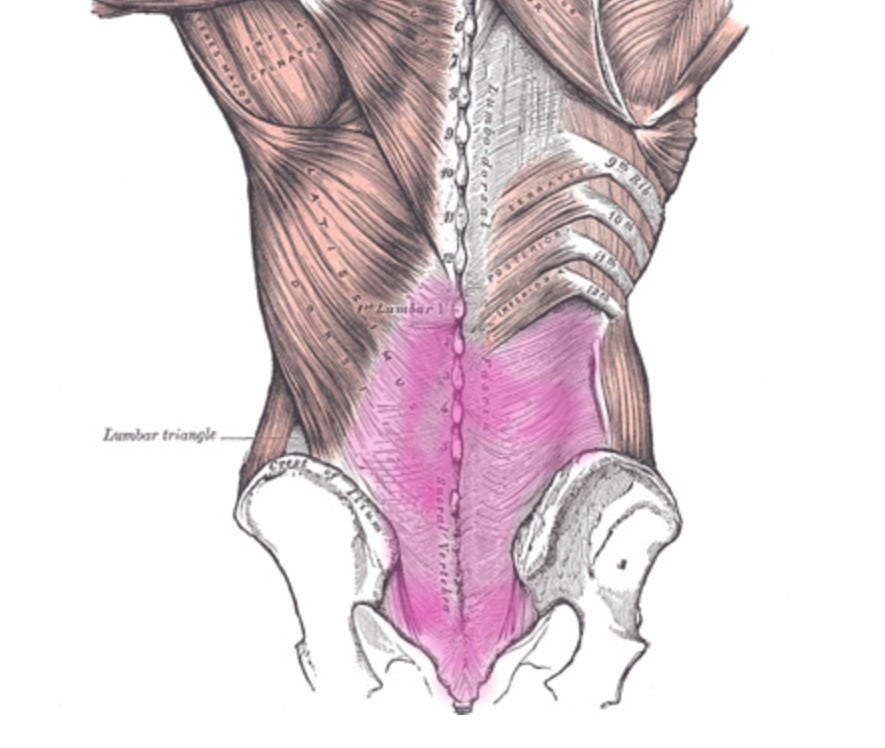
Contrary to what you may think, there is not any one muscle that is lower back. You can see in this picture, the pink shaded area is entirely fascia, its connective tissue. The lats attach to the spine through this connective tissue, but the triangular space at bottom of your spine is not actually an area that you can readily muscle up directly.
What you can do is train the spinal erectors. This is a set of muscles that run along the entire length of the spine itself.
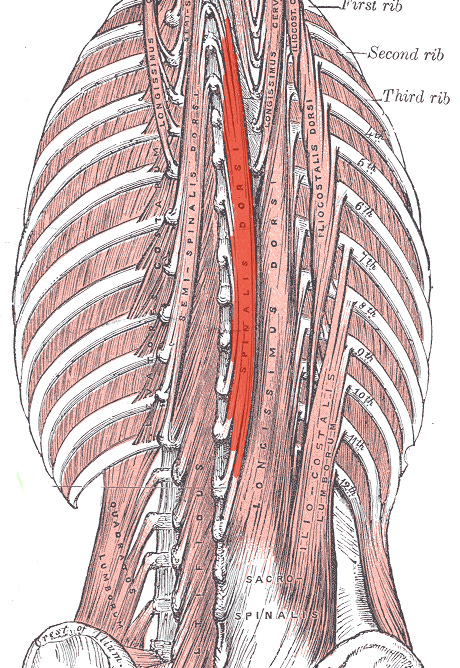
These muscles are trained isometrically during ANY back exercise. Especially during any kind of deadlift movement, they receive immense stimulus purely from the isometric contraction alone.
To Train them Directly, There are TWO great exercises to do
45 degree hyperextensions-Ive talked about this exercise dozens of times over the years. Do it with bodyweight. 2-4 sets, high reps to start with. Motion is lotion. If I had a disc injury, Id be doing these daily or Every other day.
If you can do sets of 30+ reps bodyweight, hold a weight across the chest. Doesnt need to be heavy. 10, 25, 45lbs. If you get strong at these, youre back is probably pain free.Deadlifts-If you are not comfortable with these, start with hyperextensions first. Deadlift once a week. Sets of 5. One working set in the beginning to start with. Learn proper technique. Work with a coach if you’re clueless on form.
There is of course much more to back training than these two exercises, but for disc herniations and spinal strengthening, these should be in your weekly routine.
What about PEPTIDES???
Someone will ask this. I assume they are talking about the wolverine stack in some form.
The New Wolverine Healing Protocol

The Wolverine Peptide Protocol has circulated for years in the biohacker world.
Peptides wont fix your back pain by themselves.
You need to do the physical EXERCISE. You can inject all the peptides you want. Its not fixing a fundamental lack of muscle and connective tissue integrity. Exercise does that.
Go to the gym, Train. Do your rehab. Or bodybuilding. Or bodybuilding rehab. whatever you want to call it.
Train to be strong.
I suffered from lower back pain in my 20's and into my 30's. It would hit all of a sudden and I'd be off my feet for a few days with sharp pains and tightness in my lower back. But the good news is I was able to fix it. I took the PT the doctors gave me and added some more movements and exercises to it. I do it religiously every day for over 10 years now. And I can honestly report that I have not had a single back issue now for over 10 years. I deadlift every friday morning. No issues. I'm 48 now and I feel great.
My routine is pretty simple it only takes 10-12 minutes on the floor to do. Here is what I do.
On my back:
1. Kness up rock the pelvis I call it ride the bike (make a pedaling motion while laying on your back with the your knees up) - 30 secs
2. Simple stretch pull your knees up to your chest. - 30 secs
3. Flat plank with legs straight and extended with feet up off the ground. - 30 secs
4. Bridges - 2 legs 30 secs, right leg 30 secs, left leg 30 secs, 2 legs again 30 secs
On my stomach:
1. Plank 45 secs
2. Some yoga stuff - Childs Pose, Cobra Pose, Downward Dog 30 secs each
3. Bird dogs hold each side for 30 secs
4. Finish with a pushup plank 30 secs and a set of 20 pushups
It's cured my chronic lower back pain maybe it can help you also.
Good diagram, and the sequential framing is the right way to teach it.
One piece of language I’d flag, because it costs people real money later: a protrusion is already in the herniation family. The chart has that right. It’s the everyday shorthand that splits “bulge” off as something separate and harmless, and that split tends to get quoted back at patients by someone who isn’t on their side.
The other thing I’d add is that people read a chart like this and then try to locate themselves on it from the wording of their own report. Report language is chosen by a radiologist answering one specific question, and it doesn’t always map cleanly onto four boxes. Worth having whoever ordered the scan tell you which box you’re actually in rather than deciding from a diagram.