

What does Pre-Exhaust mean?
Pre-Exhaust is a training tactic where you do isolation exercise first before compound movements. Its not a new thing, its been done since the 1950s.
Like many practices though, its goes through phases of popularity, then being forgotten.
Recently Bailey Schober on X brought it up (great coach to follow by the way)

I commented on this being a useful training tactic, and recorded a short video
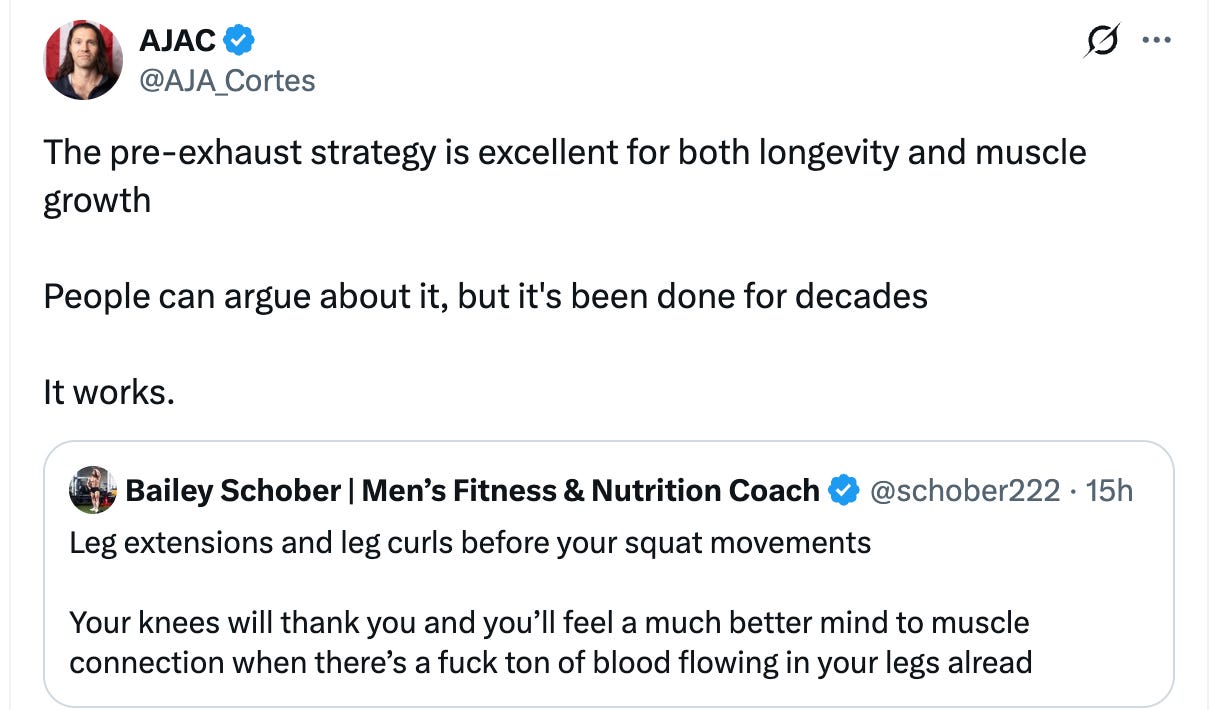


Why Would Anyone Do this though? I thought Compound movements should be done first, and isolation second?
No. You can switch the order. There is no “rule” anywhere that says exercises MUST be done heaviest to lightest.
Training compounds first is advisable for beginners
As you progress and move to the intermediate stage after your first year training, you can try different sequences.
Before we go further
-Elite Research permanently reduced the prices on some of the most popular products Use code AJAC10 at checkout
-If you a founder, operator, business owner, get yourself a Chief Health Officer to stay strong and fit while your building your business. Talk to Velocity health.
The Motivation Behind Pre-Exhaust is Insightful
Many decades ago, bodybuilders noticed that when doing compound movements, the the prime mover (meaning the main muscle being targeted and moving the weight), it often is NOT the limiting muscle in performing the exercises.
Rather its the secondary muscles.
For example, when doing a heavy bench press, the weak point in the lift is not necessarily the pectorals, but the triceps and front delts.
These secondary muscles fatigue faster than the prime mover muscle.
Bodybuilding is about stimulating muscle tissue to grow. The weight of an exercise is simply a tool, not the goal.
So how can we move a compound movement more effective at training a target muscle?
The answer, we flip the order.
You hit a single-joint isolation movement first, like dumbbell flies before chest press, or leg extensions before squats, to intentionally fatigue the target muscle.
Then, when you do your heavy compound lift, the limiting factor in the exercise becomes that primary muscle. Not the secondary muscles. They stay more fresh (meaning less fatigued).
This makes training safer, as these muscles effectively act as your bodys built-in spotters. As your chest starts to reach failure, they get recruited more and keep your joints and muscle safe because you can still stabilise the weight despite the primary mover reaching failure.
Pre-exhaust has been used by champion bodybuilders for decades this reason
You get to maximize mechanical tension exactly where you want it.
You create a intense mind-muscle connection,
and you stimulate hypertrophy.
And best of all, because the muscle is already tired, you don’t need to overload your joints with massive absolute weight on the heavy lifts to get a growth stimulus. It’s smarter, safer, and undeniably effective.
But the WEIGHT is LIGHTER!!! And the rEsEaRcH says you are WRONG.
Let me clear. I dont give a fuck what the “research” says. That said, the research isnt being interpreted correctly by whoever is saying this.
The counter arguments against pre-exhaust usually center on the following
Argument 1: It forces you to drop the absolute load on your compound lifts, thereby reducing mechanical tension.
Argument 2: The pre-fatigued target muscle shows lower overall motor unit recruitment during the main lift.
Argument 3: It generates high levels of central nervous system (CNS) fatigue early in the workout, degrading the quality of the remaining sets.
Dismantling the arguments against pre-exhaustion
While Im at a point in my career and life that I generally find it pointless to argue with people about fitness topics, I’ll address the criticisms on this.
The issue with these arguments is they all fail to account for how muscle tissue actually experiences mechanical tension in real world training
1. “The Weight is LIGHTER!”, Yes, but Absolute Load vs Local Mechanical Tension Is not the same thing
The argument that lighter weight equals less growth stimulus confuses external load with internal tissue tension. Hypertrophy is driven by the mechanical tension experienced by individual muscle fibers.
When you perform a heavy press or squat fresh, your nervous system distributes the load across multiple joints and muscle groups. If a synergistic muscle (like the anterior deltoid) is highly efficient, it takes the brunt of the work.
By pre-exhausting the prime mover (the chest), the absolute weight on the barbell drops, but the relative demand on the remaining functional fibers of the chest skyrockets. The target tissue still experiences maximum tension even though the total weight on the bar is lighter.
Again, let us revisit the fact that ALL rep ranges build muscle. That the weight is lighter does not mean that mechanical loading on the muscle disappeared.
2. The EMG DATA says theres less muscle recruitment! Okay, but EMG data is surface level, non standardized, and has no clear evidence to say its 1:1 with muscle growth
Why does EMG amplitude drop or stay flat during the compound lifts after pre-exhaustion?
Because the muscle is already tired. It cannot produce the same peak electrical output as a fresh muscle.
Theres nothing groundbreaking about that. We’d expect that to happen
However, a lower EMG reading does not mean high-threshold motor units are not working.
Lets remember Henneman’s Size Principle, which your body recruits muscle fibers from smallest to largest based on demand.
Because the target muscle starts the compound lift in a fatigued state, your nervous system is forced to bypass the low-threshold fibers and recruit those stubborn, growth-prone high-threshold motor units from the very first repetition of the compound lift, rather than waiting for the final few reps of the set. And then as the fibers drop of, you get recruitment of the smaller, more endurance based fibers, which are less likely to grow, but still have growth potential.
Id call this a win for muscle growth.
3. But Pre-exhaust creates more fatigue! SO what? Thats the point
Your muscles contract because your brain sends an electrical impulse for them to contract. This your central nervous system.
But that muscle fatigue is not the nervous system “turning the muscle off.” This is the other issue with EMG
Fatigue happens at two levels.
First, muscle fibers themselves become less capable of contracting and producing force. Calcium handling becomes less efficient, cross-bridge cycling slows, metabolites accumulate, and each individual fiber simply contracts with less force than it did a few reps ago.
Second, the nervous system gradually reduces its output as fatigue increases. This is partly a protective mechanism. Your brain is constantly receiving feedback from the working muscle about metabolic stress and mechanical strain.
But during a pre-exhaust set, peripheral fatigue inside the muscle is whats being experienced, not some big shutdown of the nervous system.
Again, thats the mechanism behind pre-exhaust that we want.
You fatigue the target muscle first with an isolation movement. When you move to the compound exercise, the nervous system doesn’t suddenly decide the muscle is too fatigued and activation drops off.
Instead it has to recruit progressively more motor units from the first set to compensate for the fact that the existing fibers are producing less force. Yes you’re using less weight, but youre making deep inroads into recruiting the big and small fibers.
The target muscle reaches a very high level of local fatigue while the assisting muscles remain comparatively fresh.
Your triceps aren’t failing before your chest.
Your lower back isn’t failing before your quads.
Your grip isn’t failing before your lats.
The weak link becomes the muscle you’re actually trying to grow.
That is bodybuilding.
Training the tissue you want to stimulate growth in.
If youre tired from this, this is why we take REST days. Lets not be obtuse here.
4. The “Built-In Spotter” Effect
When you pre-exhaust your quads with leg extensions and then do a hack squat or leg press or barbell squat, your glutes and adductors are completely fresh. They effectively act as a built-in spotter that I mentioned before. Your quads can be giving out, but you still have some control over the weight and can even get some more reps in. This also drives the mind-muscle connection (the neurological innervation to the target muscle). You can FEEL when a muscle is being worked.
For powerlifting and 1 rep maxes, you dont care about this.
But this is bodybuilding. Were developing muscle tissue and sculpting the body, not simply moving weight from point A to point B.
5. And the Biggest Benefit: Joint Longevity
The goal of training is to to build muscle, be strong, and KEEP training, year after year.
We want our train to preserve our joints, not destroy them.
Lifting big weights year after year takes a toll on connective tissue.
If you need to squat 405 lbs to fully stimulate your quads, your knees, hips, and lower back absorb that massive structural stress. If you pre-exhaust your quads with machine hack extensions first, you might get the exact same metabolic and mechanical stimulus on your quads using only 275 lbs on the barbell.
Maximizing muscular tension while minimizing joint stress is the holy grail of career longevity in bodybuilding and in LIFE.
Pre-exhaustion shifts the stress of the lift from your joints to your muscles.
Your muscles dont grow from “weight”, they grow from the muscle fibers being fatigued with mechanical tension and repeatedly contracting and lengthening.
Heavy, medium, and light weight ALL grow muscle. This has been proven conclusively across decades of broscience (and oft cited scientific research).
EVERY rep range can stimulate muscle provided the sets are intense (meaning you train close to failure).
Im SOLD! So How Do I Pre-exhaust in my training?
Firstly Pre-exhaust is intended for BIG muscles. Smaller muscles that are trained with isolation exercises, like biceps, calves, or calves, pre-exhaust is not a strategy. There are ways to sequence those muscles, but it doesnt fall under the pre-exhaust method.
The muscles you can pre-exhaust for are:
Chest
Shoulders
Back
Quads
Glutes
Hamstrings
You dont need to do this for every big muscle group. You might do it for legs but not back. You might do it for chest, but not shoulders. Its up to you, try things and see what you like.
Historically, the way most lifters did pre-exhaust was to simply put the isolation exercise first, finish the sets, and then move on to the compound movements.
This is the way I recommend doing it.
The Universal Pre-Exhaust Protocol
1.Select Your Isolation Exercise
Do this movement for anywhere from 2-4 sets, usually in the 10-20 rep range. By way of it being a more isolating movement, its not going to be done for low reps.
2.Then do your compound exercises
These can be done for however many sets and reps you like. Rep range would probably be a bit lower, say 6-10, 8-12, or 10-15.
Muscle-Specific Protocols
1. Chest (Pectoralis Major)
The Isolation exercise : Low-to-High Cable Fly or Pec Deck. Cables or machines are preferential over dumbbells because they maintain constant mechanical tension and work better with higher reps.
The Compound exercise: Incline Dumbbell Press or Converging Machine Press. Machines offer the stability needed to safely push a pre-fatigued chest to absolute failure without risking a dropped barbell.
2. Quadriceps
The Isolation exercise: Seated Leg Extension. Lean back in the seat to maximize the stretch on the rectus femoris at the hip joint.
The Compound exercise: Hack Squat, Pendulum Squat, or Leg Press. Eliminating the balance component allows you to safely hammer the quadriceps through deep knee flexion.
Another option is LEG Press before Squats
I got this combo from Coach Nash from one of his videos. He does high rep leg press, and THEN moves on to free weight squats
This takes out the low back and torso as the limiting factor.
3. Back (Latissimus Dorsi)
The Isolation Exercise: Straight-Arm Cable Pullover or Nautilus-Style Pullover Machine. This was popularized by Dorian Yates. It isolates the lats performing shoulder extension.
The Compound Exercise: Lat Pulldown or Horizontal Row. With the biceps and grip completely fresh, you can go hard on your pull movements with improved mind muscle connection.
4. Hamstrings
The Isolation Exercise: Lying or Seated Leg Curl. This targets the knee flexion function of the hamstrings.
The Compound: Stiff Leg Deadlift or 45 Degree hyper: With the hamstring pre pumped you get increased innervation from the deep stretch when doing stiff leg deadlifts.
5. Deltoids
The Isolation Exercise: Seated Dumbbell Lateral Raise. Focus on reaching and raising the weight out toward the walls, perform high reps (10+) and get a pump and burn in the side delts.
The Compound Exercise: Seated Dumbbell Shoulder Press or Machine Overhead Press: Now the delts are pumped, the rotator cuff is already warm, and again you can focus on rep quality and right weights. You only get one set of rotator cuffs.
6. Glutes
The Isolation Exercise: Cable Kickback. This targets the glutes in their fully shortened position and you get a glute pump
The Compound Exercise: Hip thrust: If you struggle to feel your glutes working on this exercise, you wont anymore. You also could do RDLs, or a reverse lunge. The effect will be the same.
In Summary
Pre-exhaust has survived 70 years of trends because it solves a problem every serious lifter eventually runs into; if you want to train forever, you must preserve your joints, not break them down.
When you are in the lifting world long enough, you eventually pick up on the pattern of men who are BUILT at 50+ are typically NOT the ones maxing out.
They are the ones who figured out how to “stimulate not annihilate”. The weight is a tool, not the end goal.
Try out pre-exhaust for 4 weeks in your training, see how you like it. You may find its the missing tactic that changes how you train long term.
This is a great solution to a problem I’ve been having with my squats. I switched to Bulgarian split squats to reduce spinal load but i find my adductors give out before my quads. Now i know how to fix that
Pre exhaust….is that when you bypass the catalytic converters to reduce the back pressure on the engine to get some more horsepower?
Sorry man…I couldn’t help it