

The squat is a foundational movement for human longevity, structural robustness, and metabolic health. The ability to bend your knees and hips together is foundational for moving through life.
Context set. We dont need to talk anymore about squatting being important.
-This post was brought to you by coffee from the gas station, and NEURVOLT. You you should try
Now lets talk about HOW to squat Better
Ive written a lot about the squat over the years, largely because its been the most challenging exercise for myself.
The Barbell Squat

For the past decade, I have written at length about the necessity of customizing exercise to suit body structure.
But in this article, I want to keep it simple
What is the ONE THING Anyone can do to improve their squat pattern?
Heel Elevation
Elevating your heels instantly enables you to squat deeper, stay more upright, put more of the load on your quads and glutes versus low back, and overall is a fantastic tactic that ANYONE can use at ANY level of training.
You dont need to be bodybuilder, powerlifter, olympic lifter. You could be 15 or 75, super experienced at lifting or a novice.
Regardless, elevating your heels will improve your overall squat technique.
WHY?
Becauase by raising the heel, you artificially increases your dorsiflexion range of motion.
Heel elevation creates whats called a negative shin angle, meaning your tibia is angled backward relative to a vertical line over the ankle/foot compared to if you were standing flat foot.
This gives you the gain in dorsiflexion, which means your knee can now travel further forward over your toes before you hit the natural end-range of your ankle mobility.
This increase in forward knee travel yields two big benefits:
Squatting with a More Upright Torso: Because the knees can track forward, the hips don’t need to shoot backwards as far to maintain balance. The torso stays more vertical. A more vertical torso means the heavy barbell on your back compresses the spine in more balanced fashion from top to bottom (axial loading) from reducing the sheer force (stress on the low back) that can happen with the torso more bent over.
This is a GOD SEND if you are one of those people with a long femurs and a short torso. No more good morning squat.Maximum Quadricep Recruitment: Hypertrophy is about placing tension on the target muscle. When the torso leans forward and hips go back, the glutes and lower back take the brunt of the load. When the torso stays upright and the knee tracking increases, the mechanical tension and load is now balanced between glutes and quads.
My Professional Recommendation is that this is an Ideal Way to Squat
Whats the BEST Way to Elevate Your Heels?
A weightlifting shoe.
Weightlifting shoes have a non-compressible, elevated heel, typically ranging from 0.5 to 1 inch (roughly 15 to 25 millimeters).
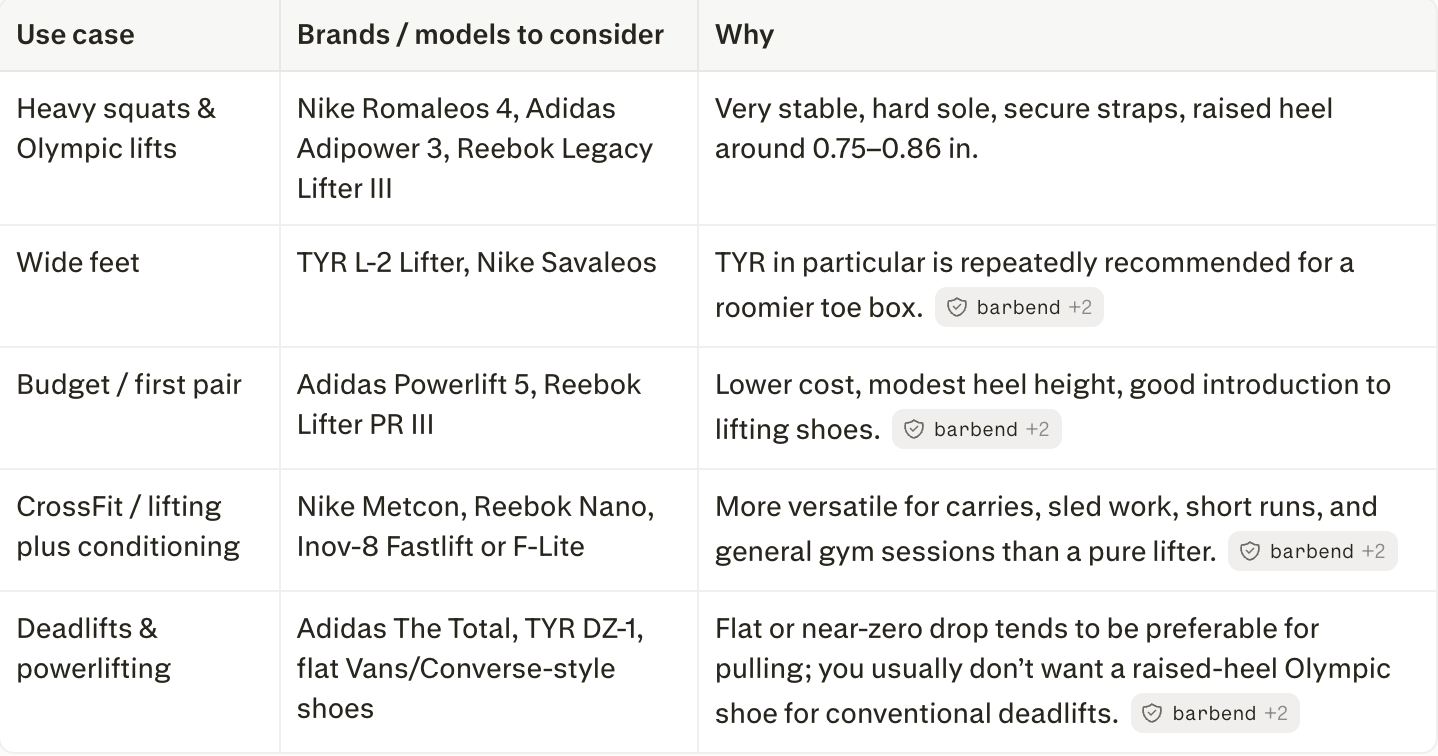
What are good brands??
I have no affiliate code or any ONE company to recommend.
Personally I have Inov8s (which Im not sure are in stock right now). I like them because they have a lot of heel elevation. I use them for Front squats.
I had my personal GPT make this table.
If you dont want to use weight lifting shoes, you can always use a 2x4