

Back in 2020 during the Wuhan Chinese Bat Gain of Function Fuck Fauci Flu lockdowns, I spent many months diving into academic journals and exploring how physical training was done in Ancient Greece and Rome.
Before We Begin
ELITE RESEARCH USA is having their 4th of July Sale.
Remember to LOGIN, use code AJAC10, and everything is 20% at minimum
Some compounds have even better deals
-30% OFF:
SLU-332 250 mcg
SLU-332 1 mg
GW-0742
O-304
Trinity 2.0
SYN
MELATONIN
50% off:
Tesofensine
Alpha GPC
I published this research in a series of newsletters, and it eventually caught the attention of an academic named Charles H. Stocking, who himself was a professor and had written a seminal text on Ancient Greek Athletics. He commended me for my scholarship and gave me a signed copy of his book.
What stood out the most during this period of research was how much the Ancient Greeks and Romans had figured out in regards to periodization, aka the science of training.
By way of observation and logical thinking, they correctly ascertained that exercise and its adaptations could be categorized, systemized, and that training should be tailored to the athlete based on the desired outcomes.
They also believed truth, beauty, and goodness to be inseparable from aesthetic FORM.
How something looked was not a surface level phenomenon, but was an multi-level manifestation of the metaphysical nature of the object itself and the divine forces that comprised it. Form and function were symbiotic with one another.
The Ancient Greeks were a truly special people, and their contributions to Western Civilization are unparalleled, both in the physical and intellectual reals.
As far back as 750 BC, it was recorded that the culture of Physicality was so dominant that every city in Greece had a gymnasium, and that men trained daily there. To train was prayer, mediation, and physical/mental development all in one.
The very origin of the word “gym” comes from the Greek Gymnasium.
The word calisthenics comes from the ancient Greek words kallos (κάλλος), which means “beauty” or “beautiful” (to emphasize the aesthetic pleasure that derives from the perfection of the human body), and sthenos (σθένος), meaning “strength” (great mental strength, courage, strength, and determination
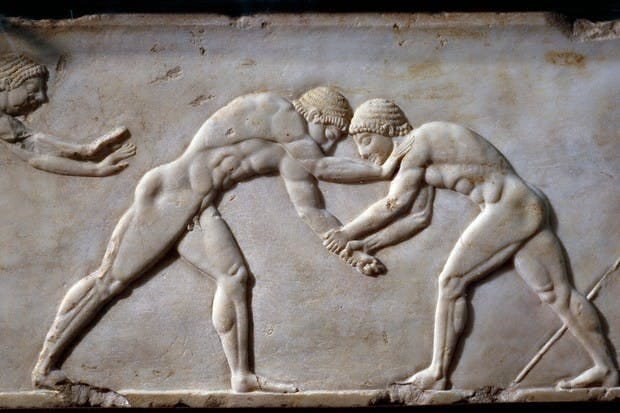
“eating alone will not keep a man well; he must also take exercise”.
Hippocrates
All this prefaced, what EXERCISES did they actually do?
While its well established that the Greeks and Romans loved athletic competition and trained as a way of life, there are not clear records of “workouts” that exist where Greek bros wrote down their exact exercises with sets and reps and weights.
They describe doing movements in a way that can be approximated to rep ranges, with some movements done a few times, and others many times, but theres no clarity like “do this for 4 sets of 8”
What does exist is excellent descriptions of the Exercises, and the intent behind them.
The Roman physician Galen, who behind Hippocrates is the most influential ancient voice in medicine, he wrote a number of guides and treatise on health, and in one them he explicitly names entire categories of exercises. As Galen was highly influenced by Hippocrates and studied ancient greek medicine, its the best record we have for how the Greeks and later Romans actually “worked out” and trained.
Finding this translation of his work, let me tell you, I was excited as hell (it was not easy to find). I have paraphrased it below for brevity, and I’ve added in my inference and interpretation of some of the exercises so they make sense. Some the translation into english is not clear (and to be fair, this is translation of a translation of a translation, so no doubt clarity has been lost)
One of the difficulties of translation is that exercise was so common practice to the Greeks and Romans that they rarely felt the need to describe anything.
It’s akin to bro culture today, there is an entire lexicon for those who are dedicated lifters, but outside the gym, the average person would not know what you are referring to.
I do not think this a complete list by any means, but its a close as one will get, and it offers bountiful insight.
Hopefully this is not too pedantic either. I could spend an entire series of emails analyzing this list exercise by exercise, (and I just might do that), but for the sake of completion, here is the full list.
Ancient Exercises According to the Doctor Philosopher Galen
This was written sometime between 165-210 AD.
Galen organizes exercises into three categories, which are very similar to modern categorizations of exercise and show a high degree of scientific insight.
Category 1 are called “Strong” exercises.
These were fundamental movements that were practiced to build strength and muscle. They are as follows
Digging (yep, this is number 1, good old fashioned manual labor)
Picking up something heavy (essentially doing deadlifts with different heavy objects)
Picking up something heavy and walking with it (what we would call a Farmers walk or loaded carry today)
Walking Uphill (as Greece is a hilly country, this is mentioned very often across many many many records on health and medicine as being integral to do)
Climbing a rope using hands and feet (this is the only pulling type movement that can be explicitly identified, and it was done quite a lot according to various records. Grip strength and a strong back were paramount for wrestling and Pankration)
Hanging onto a rope or beam as long as possible (dead hangs)
Holding the arms straight out with fist closed (this was usually done with halteres and was an isometric movement)
Holding the arms straight up with fists closed ((this was also done with halteres and was an isometric movement)
Holding out the arms while partner pulls down on them
--Side note, this would explain why all the statues always have buff shoulders, the Greeks were fanatics about doing these static arm holds. This is mentioned in other records as wellBreaking loose from a wrestling waist lock
Holding onto a person trying to escape from the waist lock
Picking up a man who is bend over at the hips and swinging him around
Doing the same but bending ones self at the hips when picking him up
--These two probably don’t make sense unless you’ve wrestled, but basically Galen is describing two different version of how to lift and throw a personPushing chest to chest trying to force the opponent backwards
Hanging from another’s neck, attempting to drag him down
--the last three require a wrestling pitEntwine your partner with both your legs around one of his and try to apply a choke or force his head backwards
the same but using only one leg to entwine both of his legs
the same but using both your legs to entwine both of his legs
For those that don’t know, thee Greeks invented three different forms of wrestling (freestyle, Greco-Roman, and Pankration), and they wrestled all the time. It was more or less what they were known for. Hence why wrestling figures so prominently into this
Category 2 are called “Rapid” Exercises.
These are movements that are cyclical (repeating) and are done quickly. Galen and Hippocrates understood pragmatically that different exercises are done at different speeds and this differentiates how they are done and how often they can be done. These are are exercises that would have been done for longer durations/sets than the prior exercise
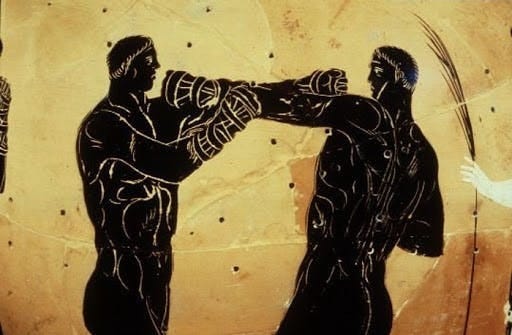
Running (short and long distance)
Shadow Boxing
Boxing
Hitting a Punching Bag (they had both heavy bags and speed bags)
Throwing and catching a small ball while running
Running back and forth, reducing the distance each time (basically they did wind sprints)
Stand on the balls of the feet, raise the arms into the air, and alternate lowering and raising the arms rapidly (while funny sounding, this is something akin to a total body calf raise done for balance)
Forward and backward rolls on the wrestling ground
Rapidly changing places with people in group formation (this would have been practice for war and being in a military unit)
Jumping and kicking both legs backwards (this trains triple extension and total body power. Imagine a person jump up and slamming a ball into the ground, or doing a vertical jump)
Kicking the legs forward alternately (in Greek Pankration, pushing and front kicking your opponent were common techniques. I’ll dive into this one at a later time)
Move the arms up and down rapidly with a closed fist, increased in speed (this sounds similar to striking drills for hand speed)
Category 3 are called “Violent” exercises
Interestingly, Hippocrates specifically warned against doing these types of exercises too often. Which makes sense, as they are the most neurologically draining. By modern standards these would largely be considered power and explosion movements, exercises that can be done only for short periods of time
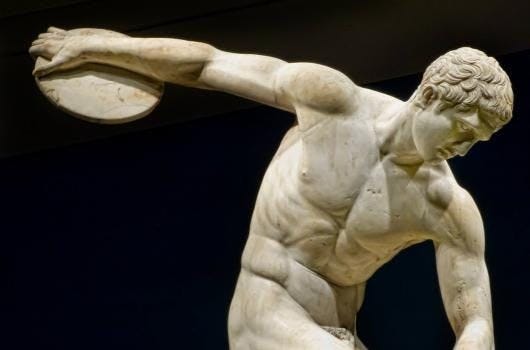
Digging rapidly
Throwing the Discus
Lifting a heavy as possible weight from the ground (the Greeks did maximal deadlifts basically)
Holding an object for a long time (Holding translates to holding something at chest/was height with the arms. This would be roughly akin to a stone lift or odd object lift today thats done in Strongman competitions. Again, there is this emphasis on static holds with weights that I find interesting)
Full and Loud Breathing (Breathing is mentioned in a few medical treatise from this era, and this seems to have been a form of forced exhalations and inhalations to build lung power, probably similar to Wim Hoff today)
Placing two weights on the ground outside of shoulder width, approximately 6 feet apart (I THINK this is a bad translation personally), then bending and picking up the left weight with the right hand, the right weight with the left hand, then setting them down and repeating the exercise many times, while keeping the feet stationary
--Okay, this last one was confusing as hell when I first read it, and I had to think about, and after experimenting, I believe its a type of rotational DEADLIFT or ROW movement. The 6 feet directions make no sense at all (you would not be able to lift the weights), but done as a sort of contra-lateral row or deadlift, its an effective exercise.
Based on that whole list, what Did they Train For?
The best approximation today would be something like a “tactical athlete”, with a major emphasis on combat.
Wrestling and running were both considered cornerstones of physical development. For combat sports like boxing, upper body strength was heavily emphasized.
They trained to lift heavy weights and carry them
They trained to strike and to wrestle
They trained to throw objects (throwing stones was a war tactic in fact)
They trained to condition the arms for endurance (based on how often they fought each other, this is sensible)
They trained the grip and the back
The TWO areas that do not get any attention by modern standards...chest, and squats.
Outside of pushups (which I am sure were done) I do not think it ever occurred to anyone in the ancient world that you needed to prioritize chest training. Bench press did not exist. They already trained to push each other around. Getting on your back and pressing weight wasnt intuitive. Bench press is a 20th century invention.
All the statues have broad shoulders, but you’ll never see any with exceptionally large chests.
Theres also no record of anyone doing squats
There are movements which appear to be akin to a walking hinge or lunges, but no description of deep knee bend squats.
I THINK they did something like a death march, a gait based RDL. Its a great glute movement.
But why didnt they squat?
My conjecture is that between the wrestling, the running up hills, the sprinting, it just wasnt necessary. Clearly they achieved aesthetic physiques without needing to do bodyweight squats. I have no doubt it was a position people did in their daily life (likely while defecating), but again, much like chest pressing, there was no connection made that “we should do this as a core exercise”. They were already training their lower body in various ways.
What Philosophical and Practical Lessons Can We Draw from These Exercises?
What impressed me the most is that the Greeks categorized training by neurological demand 2,000 years before sports science formalized the same divisions.
Strong exercises built bodily structure.
Rapid exercises built conditioning.
Violent exercises built power, and Hippocrates warned against overusing them because he understood, through observation alone, that explosive work drains something that takes longer to recover than muscle.
We call it CNS fatigue now.
The Ancient Mindset of Training would be called Tactical or Hybrid by Modern Thinking
To be strong and athletic required key capabilities.
They trained the grip, the back, the shoulders, and the legs through carries, hangs, hills, throws, and grappling.
Every movement mapped to a physical skill: lift a man, throw a stone, march up a mountain, hold your ground chest to chest.
Form and physique were an outcome of competency in these functions. The fundamentals they landed on are the same ones that still work: heavy lifts from the ground, loaded carries, hanging and climbing, hill walking, sprinting, throwing, grappling, isometric holds.
Professional bodybuilding is far removed from this.
I say that not to be critical. Its simply the reality. Were not all fighting for survival in the same way that an Ancient Man may be called upon to fight in a war. Professional bodybuilding has become specialized and the goal is attainment of an elusive aesthetic dream. No one pretends that bodybuilders are training for warfare or fighting.
Modern training starts with how you want to look and reverse-engineers exercises to produce it. The desire to look HOT or be BIG is certainly a good reason to train.
Whether this translates to longevity or adventurism or being “fit for life”, thats up to the individual. As I often say, training is N=1. Train how YOU like. From a holistic mindset and reduced to the most simple of advice, I would encourage everyone to both lift weights and do cardio. You can prioritize both.
The Greeks and Romans started with what a man should be able to do. The look then followed.
Kallos and sthenos, beauty and strength, one word because they understood it as one thing.
If you want to adopt the Ancient mindset, train for what your body should be able to do. Your physique takes care of itself. The Greeks proved it, and the proof is still standing in museums.
After two thousand years of trial and error, A man could train nothing but the above list for the rest of his life and he would be stronger, leaner, and more capable at 60 than most men are at 30.
GO TRAIN.
Gymnasium - its etymology translates to “the place to workout naked”.
I'm trying to get those Hellenic boulder shoulders!