

Every few years, someone publishes a study or a thread or an article or a reel or podcast explaining that you can build muscle with higher reps, AND lower reps.

An explanation is given that as long as you train to positive failure (or close to it), then any rep range can build muscle.
Low reps like 5-8 reps will build muscle.
And moderate reps like 8-12 reps will build muscle.
And even HIGH reps like 12-20+ will build muscle.
ALL rep ranges can be used to build muscle, and get stronger.
If the impressions are high enough, then the “normie” internet reacts as if biology has been miraculously updated and its a world shattering idea.
Cue the cringe-WOW, I LOVE SCIENCE!!!
Most recently it was a conversation between Dr. Rhonda and Chris Williamson


Except NONE of this is a New Discovery
At all.
The “studies” that demonstrate all reps ranges are stimulating for muscle growth are post hoc evidence of phenomenon and practice that has been known for thousands of years
In the 3rd century AD, the Greek philosopher Philostratus wrote a text “Gymnasticus”, that detailed athletic training and described how exercises could be done for many or few repetitions.
While it did not describe reps in the “bodybuilding” sense of modern times, it is obvious from the text that ancient athletes understood the concept of 1 rep maxes, heavy exercises being done for few repetitions, and lighter movements being done for more. This was identified then as build strength and muscle in the body.
Fast forward in time to the late 1800s and early 1900s, and multiple texts are written “Scientific Training”
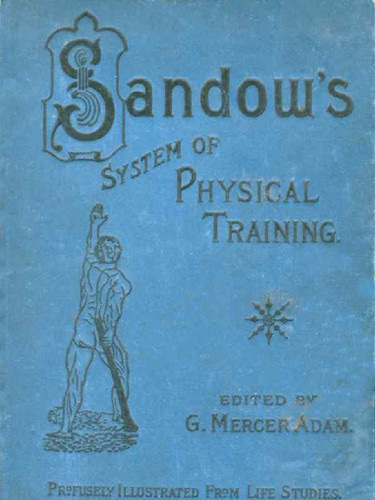
Again, the same concept of low, moderate, and high reps are described.
Our ancestors intuitively understood this.
American Bodybuilding for 100+ years has recommended low, moderate and high reps
1940s Bodybuilding champion John Grimek desribes the merit of using different rep ranges in this article, written in 1991
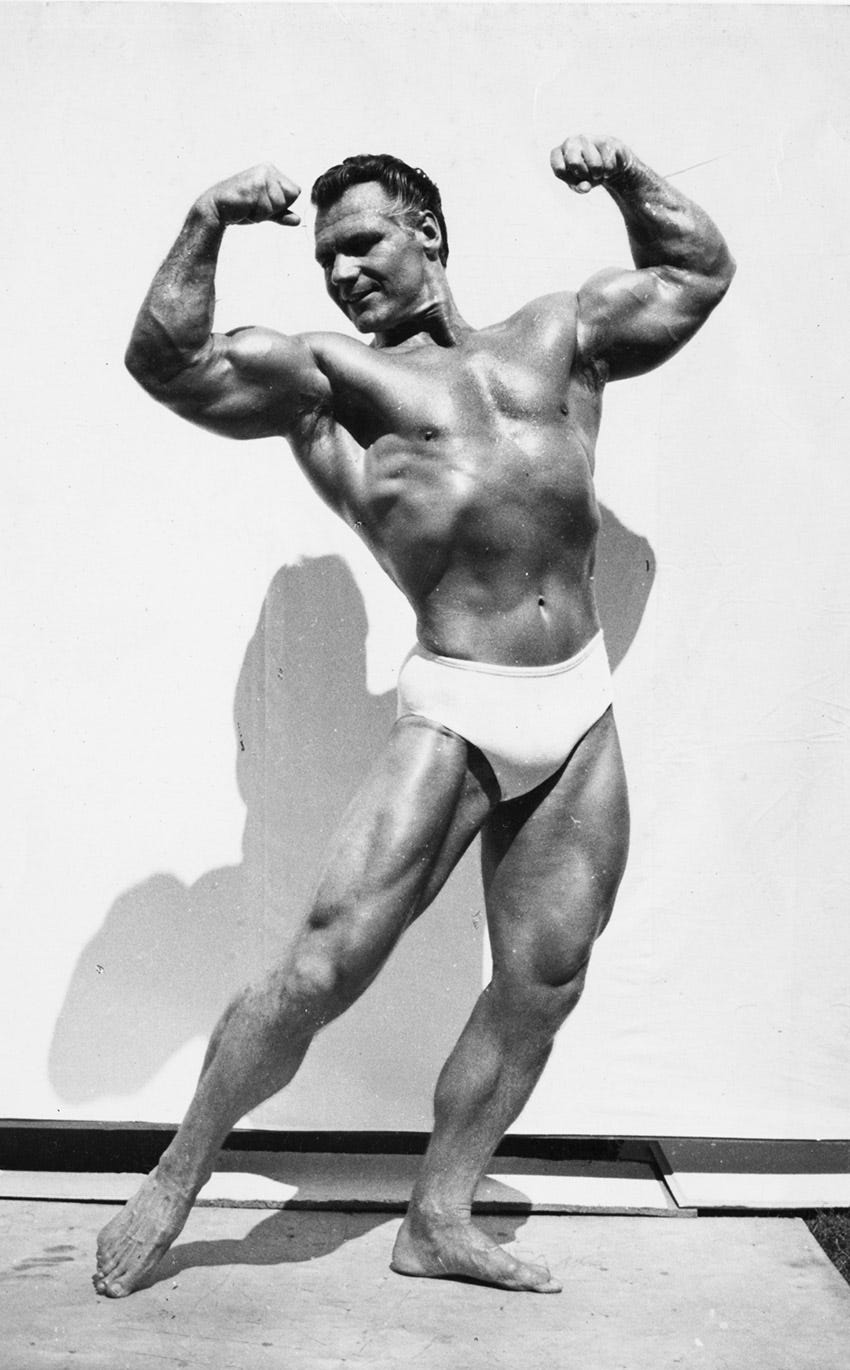
John Grimek didnt need a “study” to know you can use all the rep ranges
I could list out a dozen more bodybuilders, strength coaches, and legendary lifters who all share similar observations
ALL REP RANGES CAN BUILD MUSCLE
Rep ranges from roughly 5 to 30 can build muscle, provided the sets are taken close enough to failure and progressed over time.
Again, this is not new science.
It’s old training knowledge that keeps getting repackaged because the latest generation of the general public was not around, or weren’t paying attention, the last time it was explained.
Fitness marketing thrives on selective amnesia.
Muscle Respond to Intensity
Muscle grows in response to tension, fatigue, and sufficient volume accumulated near failure. The muscle fiber does not count reps. It responds to effort.
If a set is:
hard enough
close enough to failure
repeated consistently
progressed over time
…it can stimulate hypertrophy.
This is why you can build muscle with:
heavy sets of 5–8
moderate sets of 8–15
lighter sets of 15–30
The biological outcome is the same.
The reason the “middle” rep range became pseudo gospel isn’t because other rep ranges don’t work.
It’s because it’s the most forgiving and easy to understand range for most people.
Do about 10 reps. Try to lift weight thats challenging. Do more next time.
It balances load, fatigue, joint stress, and progression better than the extremes.
Its practical, and hard to mess up.
If All Rep Ranges build muscle, how are you supposed to know what range to use??
This is the inevitable question people have.
Being told to use any range they want is freeing, but then theres no constraint that provides guidance.
My directives on this are simple and grounded in real world practice and science
1-4 Rep Range-Maximal Strength.
Not a normal range for anyone to train unless you’re a competitive olympic lifter, powerlifter, or strongman. Barbell lifts are typically the exercises that people do for 1 rep max efforts. Barbell lifts are designed for max stability.
During regular training, doing sets of 1-4 reps as “work sets” is not a useful strategy outside of prepping for a powerlifting competition. The risk of injury is high, the neurological demands are high. The weights are so heavy that you are “testing” strength, not building it.
5-10 Range-Strength and Hypertrophy
Getting stronger in the 5-10 ranges meaning moving meaningful weight, recruiting high-threshold motor units early, and you create a strength-hypertrophy overlap.
This range is efficient. You can get a lot out of relatively few sets. You stimulate muscle tissue for growth, you get stronger.
Many popular programs are based around doing sets of 5. This works great for beginners.
5-10 reps a set works for barbells, dumbbells, cables and machines.
Its almost universally effective. You can make adjustments to this, such as 6-10 or 60-12 reps, but these differences are minor.
Train with weights that 70-80% of your 1 rep max, take sets to failure (or close to it). Increase the numbers of reps you can do, add weight, repeat.
This is what progressive overload is.
10–20 Reps: When it works, it works really well
High-rep training builds muscle the same way that lower rep training does, with added mechanisms of metabolic stress, and prolonged tension and strength endurance. This rep range grows muscle just fine, if the sets are taken close enough to actual failure.
The human body is not uniform in its genetic response. Every year, there are people who try “higher reps” for legs or some other muscle group, and they find they grow more, the lighter weights are friendlier to their joints, and its complementary to lower rep exercises.
Increasing your 20 rep max wont increase your 1 rep max, but getting stronger in the 10-20 rep range is REAL strength.
This doesnt always work well for every exercise, because sometimes stabilizer muscles or other muscles tire out before the main one that youre trying to target. Regardless high reps have their place in training
The TL;DR Framework
An experienced lifter who understands training doesn’t argue about rep ranges. They use all of them.
1–4 reps: practice maximal strength
5–10 reps: build the muscle that supports it
10–30 reps: build volume tolerance and joint-friendly hypertrophy
You can use ALL the rep ranges. Some exercises you do 5-8, others, 8-12, or 6-12, or 10-15, etc. There are no rules, only principles
Muscle grows from effort.
Strength from Progressive overload.
If something is working, keep doing.
Download the A-Z BroScience Guide to peptides
Order your Fitness Genes test