

2026 is almost here.
Health goals will be made.
Will be they kept? This is the question. Hopefully YES.
If Fat loss is one of your goals, join the Accelerated Fat Loss Challenge for Men. Its a group coaching experience thats producing amazing results for everyone that participates. Make 2026 a transformative year
It starts January 1st (and runs for 8 weeks)
Strength Training is one of the holy grails for Longevity
The benefits of being strong with muscle are inarguable, we get
Increased muscle mass
Improved bone density
Enhanced metabolic rate
Better joint stability
Improved balance and coordination
Reduced risk of injury
Better blood sugar regulation
Lowered blood pressure
Reduced symptoms of anxiety and depression
Improved sleep quality
Healthy weight management
Enhanced cognitive function
Reduced risk of chronic disease
Improved posture
You probably dont need an article convincing you these things are good for you.
Lets talk about training, and how often we should lift weights.
Im going to make an assumption
You workout because you want to feel stronger and have more energy
Your motivation for training is not because you want to feel burned up, sore, stressed, fatigued, and hobbling around from your workouts
There is a dividing line that exists between hardcore people who structure their life around lifting, and people who want lifting to fit their life
If this speaks to you, I have an answer
A simple answer,
Strength Train 3x days a week
Why? Because this WORKs.
3 Day Routines check every possible box of health benefits.
They are practical.
They are adaptable.
They work for everyone. They work whether you have higher level physique goals, they work whether you are busy with work, they work whether you have limited time.
They for men. They work for women.
They work for strength gains, muscle gains, fat loss, recomposition.
Why 3 Days a Week ROCKS
Longevity and Systemic Inflammation Management
For anyone focused on health span, training six days a week can readily creates a state of chronic, low-level systemic inflammation. You are constantly digging a recovery ditch that you never quite fill back up. You have No margin for error with recovery. And the older you get, the more recovery time you need.
By training three days a week (e.g., Monday, Wednesday, Friday), you guarantee four days of total systemic recovery. This allows cortisol levels to normalize, inflammation to subside, and deep tissue repair to occur. This is how you build and train a body that functions as well at 50 as it did at 25.
Intensity Preservation
For the serious lifter, frequency is the enemy of intensity. You cannot train with true, bone-crushing intensity six days a week without burning out or getting injured.
When you know you only have three sessions, you can (and must) push those sessions to the limit. You can take sets to failure, move heavy loads, and empty the tank, knowing you have a full 48 to 72 hours before you need to perform again.
Radical Consistency
The “best” program is the one you can stick to for a decade. A 6-day program has a high churn rate; miss one day, and the schedule collapses. A 3-day program is anti-fragile. It absorbs life’s chaos. If you miss Monday, you train Tuesday. The low frequency ensures that “Average Joe” stays consistent enough to become “Above Average Joe.”
Historical Proof (The Classic Age)
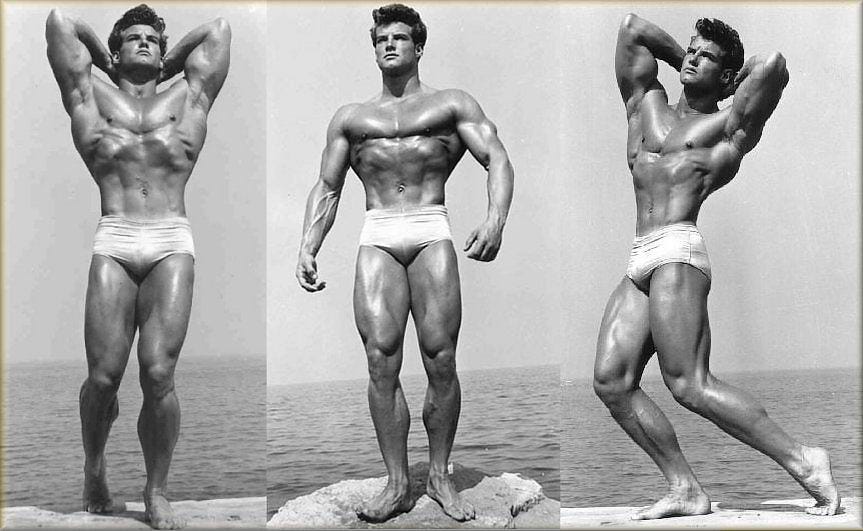
Natural bodybuilders from the pre-steroid era (pre-1960s) achieved peak muscularity training and used 3 day a week training programs as their “base” routines
The most famous example is Steve Reeves, a legendary physique icon, followed a full-body schedule three days a week.
Modern natural bodybuilders are not any larger than than these classic lifters, despite often training with much higher frequency and volume.
The Science of Gains
Volume vs. Frequency: The “Equalizer”
A significant finding in modern exercise science is that weekly volume (total hard sets per muscle) is a major driver of growth, and frequency seems secondary.
A landmark 2019 systematic review and meta-analysis by Schoenfeld et al. analyzed 25 studies comparing different training frequencies. The researchers concluded that when volume is equated (e.g., 12 sets of chest done in one day vs. 4 sets done over three days), there is no significant difference in muscle hypertrophy.
The Takeaway: Provided you train consistently, you can get great results in less training days so long as volume is sufficient
The 3-Day vs. 6-Day Showdown
Specific studies have directly tested the “bro-split” or 3-day approach against high-frequency training to see if “spreading out” the work is superior.
It generally isn’t.
A 2018 study by Colquhoun et al. published in the Journal of Strength and Conditioning Research took experienced powerlifters and split them into two groups: one training 3x per week and the other 6x per week. Both groups performed the same total volume.
The Result: After 6 weeks, there was no significant difference in strength gains (Squat, Bench, Deadlift) or fat-free mass between the groups. The 3-day group got just as strong and big as the 6-day group.
The Takeaway: This is a short term study, but the fact there was no significant difference between the two blows apart the idea that lots of training is going to give super duper levels of results.
You only need to lift SO MUCH.
The “Bro Split” Validation (Split vs. Full Body)
A common critique of 3-day splits (like Push-Pull-Legs or Upper/Lower) is that you only stimulate each muscle once a week. However, science suggests this frequency is sufficient if the per-session intensity is high.
A 2022 study by Brigatto et al. compared a “Split Body” routine (muscles trained 1-2x week) vs. a “Full Body” routine (muscles trained 3x week) in resistance-trained men.
The Result: Both groups achieved similar increases in maximal strength and muscle thickness. The researchers concluded that split routines performed 2-3 times per week are equally viable strategies for hypertrophy compared to higher frequency full-body training.
The Takeaway: Again, we see a similar conclusion that training hard and consistent matter far more than any magic around scheduling.
The Physiology of Recovery
Training 3 days a week (e.g., Mon/Wed/Fri) guarantees 48–72 hours of systemic recovery between bouts. This aligns perfectly with the physiological timeline of muscle protein synthesis and nervous system recovery.
Muscle Protein Synthesis (MPS): While MPS spikes for ~24-48 hours after training, systemic inflammation and CNS fatigue can linger longer.
Diminishing Returns: Research indicates a “per-session volume cap.” Doing more than ~10-12 hard sets for a single muscle group in one workout yields diminishing returns (the “junk volume” threshold). A 3-day split allows you to hit this threshold perfectly for specific body parts (e.g., 8 sets of chest on Push day) without crossing into “junk” territory, which often happens when people try to cram too much into training 5-6 days a week and just end up overtraining
Practical Considerations: Unless you are a physique athlete or pro athlete, most people are NOT interested in being beat up from training all the time. The goal of your daily life is not be exhausted from workouts. You train for strength and energy, not fatigue and stress. 3 days of training gives you 4 days to recover
The Curve of Diminishing Returns
Natural muscle growth is finite.
A natural trainee will hit their upper bound of their genetic limit faster than people realize (usually within 2–3 years).
Higher frequency might help you reach that limit slightly faster, but it does not change the limit. Whether you train 3 days or 6 days, you end up at the same destination.
If your goal is to maximize your physique, by all means train more and figure that out for yourself
But Practically Speaking: 3x a week is going to get anyone 90% of the way there
Efficiency vs. Enjoyment
Ironically, in professional sports, 3 times a week of strength training is considered a standard recommendation and formula.
The ONLY athletes who do way more training are bodybuilders.
But people who train 5–7 days often do so because they enjoy the process, the pump, and the lifestyle, not because it is strictly necessary for growth.
Practically Speaking: If your goal is to be a competitive bodybuilder, do what you want. Everyone else, a 3x schedule works great.
The Bottom Line:
If you can execute that work in 3 days, your physiological outcomes will be indistinguishable from someone training 6 days,
but you will likely have BETTER joint health and more FREE TIME.
The Training Options
You have two paths to take here.
Push Pull Legs.
Upper/Lower.
Lets cover Push Pull Legs First
